Progressive Web Apps vs Native Apps: Which Belongs in Your Product Strategy?
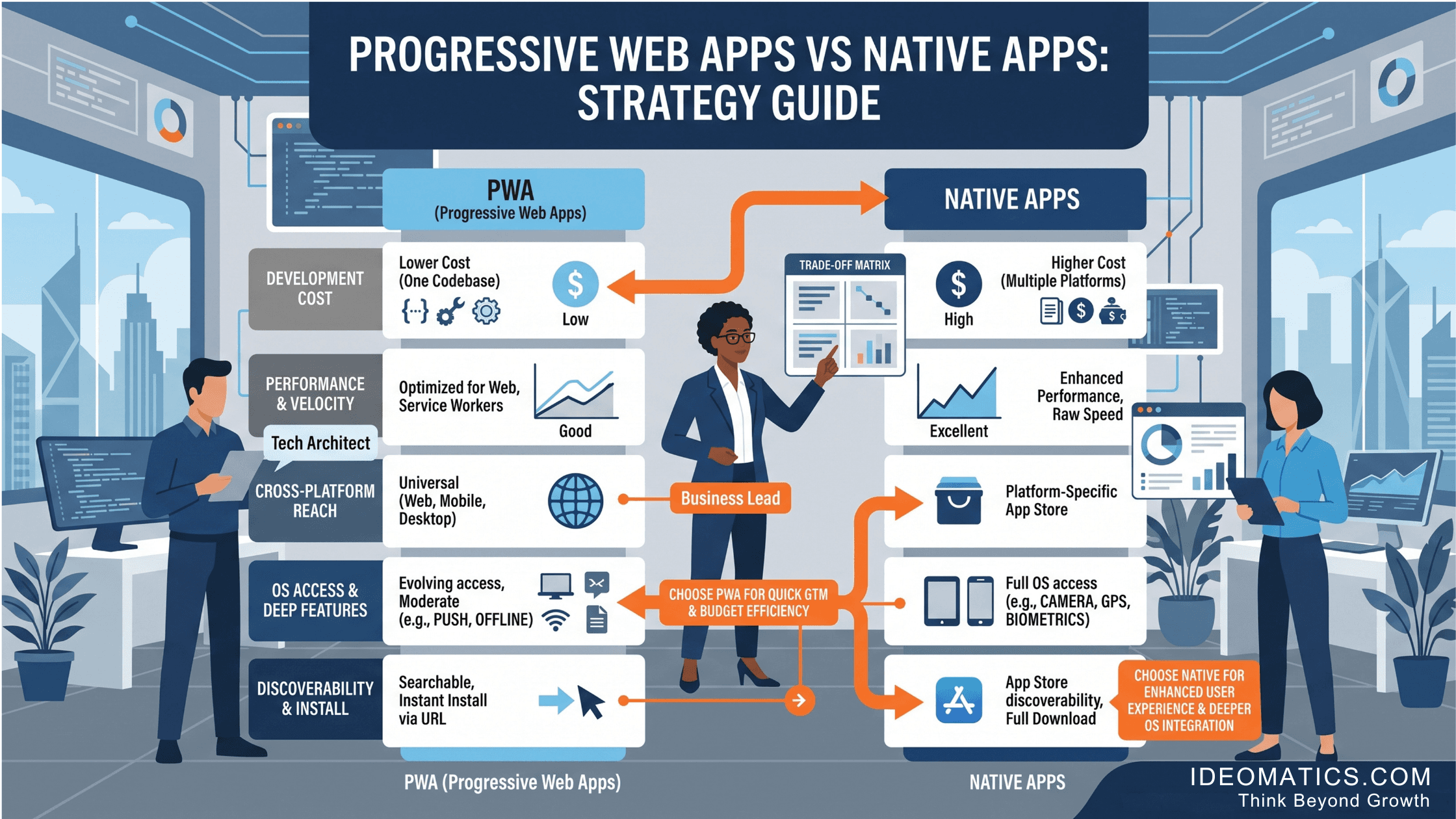
Choosing between progressive web apps vs native apps depends on your performance requirements, feature needs, and audience distribution. If you need fast market access and single-codebase maintenance, progressive web apps deliver immense speed and flexibility. If your product relies on deep hardware access, native applications remain superior.
At Ideomatics, we help founders and operations leaders make clear architectural choices. Building software requires balance between budget efficiency and user experience.
How do progressive web apps compare to native apps?
Progressive web apps run directly in web browsers while delivering app-like experiences. Native apps install from application stores and run directly on mobile hardware.
PWAs use modern web technologies like service workers and manifest files. Native software uses specific platform languages like Swift or Kotlin.
When choosing between a web app vs native mobile app, platform friction matters. PWAs allow users to bypass store approvals and installation steps. Native applications deliver higher compute performance and complex graphic processing.
Core Architectural Differences You Must Understand
Architecture determines how your application scales over time. Web applications run within standard browser sandboxes. Native apps interact directly with operating system interfaces.
This difference affects feature access, update speed, and distribution. PWAs receive background updates instantly whenever you publish new code. Native releases require store review processes and manual user updates.
For businesses targeting global markets, deployment speed offers a major advantage. Our team delivers custom production-grade web platforms designed for maximum reliability across devices.
Realizing Key PWA Benefits for Business
Understanding pwa benefits for business helps teams allocate capital wisely. Web applications reach desktop and mobile users simultaneously through one codebase.
You eliminate the need to maintain separate iOS and Android development pipelines. Lower maintenance overhead allows your team to iterate rapidly on core features.
PWAs also improve organic discoverability through standard search engine optimization. Search engines index web pages directly, helping you acquire traffic without store listing costs.
Furthermore, lightweight caching allows users to load content reliably on poor mobile networks. This responsiveness increases conversion rates across emerging and established international markets.
Evaluating the Real Cost of PWA Development
Analyzing the cost of pwa development requires looking beyond initial launch fees. A single web codebase reduces initial development effort significantly.
Building separate native apps requires two complete development teams and doubled testing routines. A unified web strategy cuts immediate engineering hours by up to forty percent.
Longer maintenance timelines also show significant financial savings. You write bug fixes once and deploy them instantly to every user worldwide.
If your application requires rapid feature iteration, web architectures protect your burn rate. Learn how our app development services match platform strategy to long-term business goals.
When a Progressive Web App Is Not the Right Fit
PWAs are not a universal solution for every product vision. Choosing web technology for hardware-intensive features often leads to frustration.
If your product relies heavily on continuous background location tracking, native software is mandatory. iOS restricts certain background features and web notification APIs for PWA installations.
Similarly, applications requiring complex 3D rendering or high-frame rate graphics demand native GPU access. In these scenarios, choosing a web app results in performance bottlenecks.
Forcing a web technology onto a native problem damages user trust. We advise clients honestly when native engineering provides the only viable path forward.
Strategic Checklist for Your Product Roadmap
To pick the right path, evaluate your audience and product requirements carefully. Answer these core questions before committing your engineering resources:
First, do your users demand store presence for brand credibility? Second, does your core feature set require advanced hardware access like Bluetooth LE?
Third, how critical is immediate market launch to your commercial success? If fast deployment and search discovery drive your strategy, start with a web app.
If deep platform integration and raw processing power drive retention, build native codebases. We offer technical software architecture consultancy to help you navigate these trade-offs confidently.
Frequently asked questions about progressive web apps vs native apps
How much does progressive web app development cost?
Progressive web app projects typically cost thirty to fifty percent less than building dual native apps. You save significant budget by maintaining a single codebase across desktop and mobile devices. Initial engineering investment usually ranges from moderate web platform budgets up to enterprise software scales.
How long does it take to build a progressive web app?
Most commercial progressive web app builds take eight to sixteen weeks from design to deployment. Timelines vary based on dynamic feature requirements, backend integrations, and platform testing scope. Building one unified web product saves months compared to native multi-platform releases.
What is the process for migrating a web app to a PWA?
Migrating an existing web platform requires adding a web app manifest and implementing service workers. You establish offline caching strategies and configure HTTPS security protocols across your infrastructure. Our engineering team refactors front-end components to ensure responsive performance across mobile screen sizes.
How do I choose between a PWA and a native app?
Choose a progressive web app if you prioritize rapid market launch, search traffic, and lower engineering budgets. Select a native app if your software demands complex hardware access, intensive graphics, or deep operating system integration. Evaluate user expectations and functional hardware needs before selecting your stack.
What happens if a PWA fails to meet user performance expectations?
Performance failures in PWAs usually stem from unoptimized assets, poor caching rules, or heavy JavaScript bundles. Engineering teams resolve these issues by auditing bundle sizes, optimizing database queries, and improving caching logic. If hardware limitations cause the bottleneck, converting key modules to native code becomes necessary.
Work with Ideomatics to Build Your Platform Strategy
Selecting the right product architecture sets the foundation for your business growth. At Ideomatics, we design scalable web applications and native solutions tailored to your operational goals.
Whether you need rapid market entry or robust enterprise systems, our engineers deliver measurable engineering excellence. Explore our proven software portfolio to see how we help growing businesses succeed.
Ready to evaluate your technology stack with senior software experts? Contact our engineering team today to start your product discovery conversation.