Custom AI Agent Development Company Selection Guide
Selecting a custom ai agent development company requires evaluating software engineering discipline and security protocols. The best partner builds deterministic fail-safes into probabilistic language models. They bridge the gap between experimental artificial intelligence and enterprise software systems.
Finding the right team requires looking beyond basic application programming interface wrappers. You need an engineering studio that understands software architecture and boundary controls. We at Ideomatics help organizations build scalable, secure software products that drive actual value.
How to Choose a Custom AI Agent Development Company
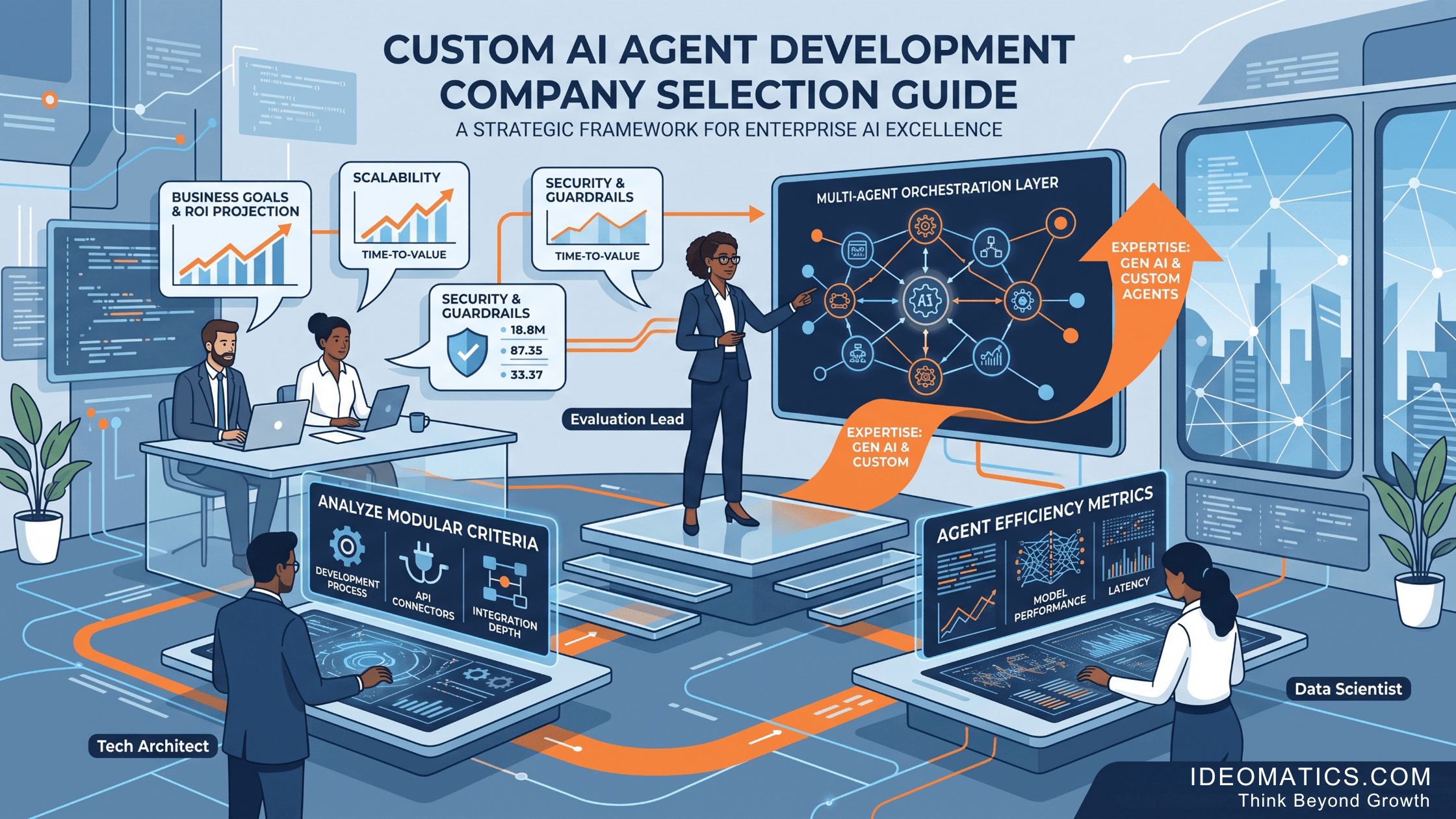
You choose a custom ai agent development company by evaluating engineering practices, state management, and enterprise integrations. Look for teams that write maintainable code, build deterministic fallbacks, and design secure tool-calling pipelines. Avoid agencies that rely solely on simple prompt engineering without underlying software infrastructure.
Many vendors promise rapid deployment of intelligent bots. However, production systems require strict validation, data privacy, and reliable backend connections. Software stability depends on how systems manage failure modes under heavy load.
When evaluating vendors, ask for technical specifications rather than simple marketing demonstrations. Review how they handle application programming interface rate limits and database transactions. A true software partner provides complete transparency into their development methodology.
Core Engineering Standards for Enterprise AI Agents
Building intelligent software requires modern architecture and strict engineering standards. A competent team treats language models as sub-components inside larger software systems. This structure ensures predictable performance across complex business workflows.
We at Ideomatics design workflows around strict schema validation. Every model output must match expected data types before triggering subsequent system actions. If an output fails validation, the system safely triggers a structured fallback mechanism.
Your engineering partner must implement comprehensive observability tools. Real-time tracing helps engineering teams monitor token consumption and execution latency. It also reveals exact agent decision pathways across every execution step.
If you want to review our engineering capabilities, explore our applied AI engineering services. We build reliable software tailored to your specific infrastructure requirements.
Evaluation Checklist for LLM Agent Integration Services
Connecting language models to legacy enterprise software presents serious technical challenges. You need specialized llm agent integration services to connect external systems securely. Proper integration preserves data integrity across all connected platforms.
First, check if the agency constructs explicit schema boundaries around external tools. Agents should never receive unrestricted database access or direct operating system privileges. Every tool call must pass through authorized permission layers.
Second, review how the studio handles credential safety. Token rotation, role-based access control, and encrypted secret storage must be standard practice. Exposing raw credentials inside prompts creates major security vulnerabilities.
Third, ensure the studio writes extensive integration tests. Mocking external service outages during automated testing prevents catastrophic production failures. Test suites must verify system behavior under network latency and degraded API states.
Production Safety and Deterministic Workflows
Language models generate probabilistic responses, but enterprise processes require consistent results. Bridging this gap requires strict deterministic code layers around model calls. The surrounding code controls execution flow and enforces business rules.
A reliable development studio builds state machines to govern agent transitions. If an agent strays from allowed transition pathways, execution stops immediately. This approach prevents infinite loops and unintended side effects.
Human approval mechanisms are essential for high-risk operations. Actions like issuing refunds or modifying master records should require human sign-off. The software should queue sensitive tasks for manual review seamlessly.
You can learn more about our software engineering philosophy on our company overview page. We focus on building resilient systems that protect operational continuity.
Deploying Autonomous AI Agents for Business Efficiency
Deploying autonomous AI agents for business automation can significantly improve operational efficiency. However, broad autonomy requires a cautious, phased rollout strategy. Gradual introduction minimizes disruption to ongoing operations.
Start with narrow, well-defined tasks like internal ticket triage. Measure accuracy, execution speed, and operational cost before expanding responsibilities. Controlled pilots expose edge cases without risking customer relationships.
Incremental deployment allows technical teams to refine system behavior under realistic conditions. It builds trust among staff members and stakeholders. Demonstrating early success simplifies change management across the company.
Teams should also maintain comprehensive evaluation suites. Testing prompt updates against historical logs prevents performance regression over time. Continuous benchmark testing ensures high output quality across releases.
When Custom AI Agent Development Is Not the Right Solution
Custom software engineering is not always the correct choice for every organization. If your operational processes change weekly, standard forms or basic rules perform better. AI agents require established, consistent workflow patterns to function effectively.
Custom agent architecture demands stable underlying data structures and reliable APIs. Building autonomous systems on top of undocumented endpoints creates constant operational failure. You must fix underlying data debt before introducing intelligent automation.
Off-the-shelf software products are often better for simple FAQ bots or document search. Bespoke development makes sense when complex tool execution and custom reasoning are mandatory. Evaluating existing software options first prevents unnecessary custom engineering expenses.
If your technical infrastructure or budget is limited, custom software creates unnecessary risk. Start with straightforward workflow automation to streamline basic bottlenecks. Explore our targeted automation services to improve foundation systems first.
Architecture Patterns for Enterprise AI Agent Development
Successful enterprise ai agent development relies on modular microskills rather than single prompts. Breaking complex assignments into specialized sub-agents improves accuracy. Smaller, focused prompts are easier to test, debug, and maintain.
Orchestration agents evaluate incoming requests and route work to specialized agents. Each worker agent operates with distinct instructions, tools, and execution boundaries. This separation of concerns prevents instruction drift across multi-step processes.
Memory architecture must distinguish short-term task context from enterprise memory. Vector indexes, relational databases, and key-value stores perform distinct roles. Proper memory partitioning keeps data access fast and secure.
Modularity ensures that modifying one feature does not disrupt the broader software ecosystem. Your software remains flexible as business requirements change.
Frequently asked questions about custom ai agent development company
How much does it cost to get started?
Initial scoping and proof of concept builds typically cost between ten thousand and twenty-five thousand dollars. Full enterprise agent platforms with bespoke integrations cost more based on system security and complexity. We provide clear project estimates after conducting initial technical reviews.
How long does an agent deployment take?
A focused pilot project takes four to eight weeks from initial discovery to pilot deployment. Complex enterprise deployments with multi-agent orchestration take three to six months to complete fully. We establish clear milestones throughout the development cycle to track progress.
What is the process for testing AI agents?
We test agents using deterministic evaluation suites, historical scenario replays, and automated red-teaming. Every prompt or code update passes through regression tests to ensure output consistency. This comprehensive testing pipeline prevents unexpected model behavior in live business environments.
How do you choose between custom agents and off the shelf tools?
Choose custom agents when you require bespoke API integrations, proprietary security boundaries, and custom workflows. Use off the shelf software for basic document lookups or standard customer inquiry templates. Custom development offers complete control over your technical stack and data security.
What happens if an AI agent makes a mistake in production?
Deterministic guardrails catch invalid agent outputs before execution and trigger automated fallback routines immediately. System administrators receive real-time trace alerts to review blocked actions promptly. Engineering teams then update prompt instructions or schema constraints to prevent recurrence.
Build Reliable AI Agents with Ideomatics
At Ideomatics, we build custom software that solves difficult business challenges. We partner with ambitious teams to engineer reliable, enterprise-grade AI software. Our studio emphasizes software architecture, code quality, and continuous system testing.
We work as a transparent extension of your internal technical staff. Our engineers bring technical excellence to every stage of product design. We ensure your digital products are built for long-term operational success.
If you are ready to deploy production-grade agent software, reach out through our contact page. Schedule a consultation with our team to discuss your project requirements today.