Custom LLM Fine Tuning for Enterprise: A Safe Guide
Custom LLM fine tuning for enterprise adapts open models to your domain using your proprietary data while ensuring strict control. You can safely train models in isolated cloud environments without sharing sensitive inputs with third parties. Our engineering team helps businesses build secure AI systems without compromising on performance.
Deploying internal artificial intelligence requires balancing innovation with strict risk management. Proprietary operational data gives your business a distinct competitive advantage. Protecting that data during training must remain your highest strategic priority.
What is custom llm fine tuning for enterprise and why is it secure?
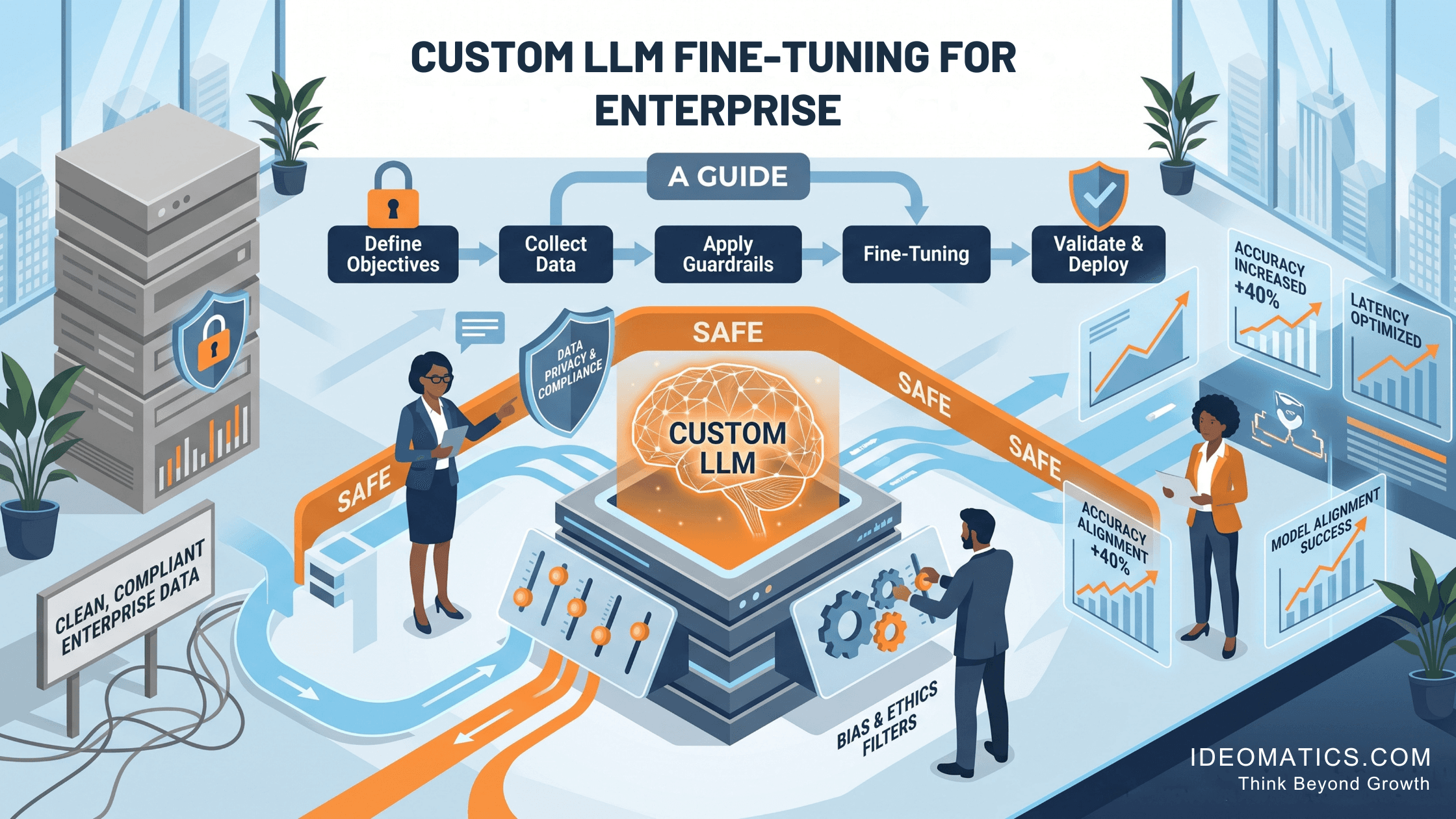
Custom LLM fine tuning for enterprise updates an open-weights foundation model using private internal data inside your isolated tenant. This approach prevents third-party data collection and preserves complete privacy. You maintain full ownership of all model weights, datasets, and training logs.
Standard commercial APIs often train on your user queries and internal documents. Fine-tuning an open model in your cloud prevents that vulnerability entirely. Your team controls encryption keys, network perimeters, and access permissions.
Furthermore, fine-tuned models run on dedicated compute infrastructure. No outside organization can monitor your request volume or inspect your outputs. This isolation guarantees complete control over your sensitive intellectual property.
Establishing strict enterprise ai security parameters
Robust enterprise ai security begins at the network perimeter. You should host your training infrastructure inside a dedicated Virtual Private Cloud. Keep all training nodes disconnected from public internet access during model updates.
We recommend parameter-efficient training methods like Low-Rank Adaptation for most enterprise use cases. These methods reduce hardware requirements drastically while preserving base capability. They also allow you to swap specialized adapter weights without exposing core model weights.
Role-based access control must restrict who can trigger training runs or export model weights. Audit logs should capture every data transformation step across the pipeline. These controls build a verifiable chain of custody for compliance audits.
Encrypting data both in transit and at rest prevents unauthorized access. Storage buckets holding raw training text should use customer-managed encryption keys. Hardware isolation further protects temporary compute caches during heavy training runs.
Preparing datasets through private data fine tuning
Successful private data fine tuning requires careful data hygiene before training begins. Raw enterprise documents often contain sensitive personal information or proprietary financial records.
You must run automated sanitization scripts to redact confidential customer identifiers. Tokenize or hash internal customer keys before feed generation starts. This pre-processing step ensures that sensitive tokens never enter model memory.
Clean datasets yield predictable model outputs and improve training efficiency. Removing redundant text reduces GPU time and lowers training costs significantly. Structured formatting allows the model to learn domain terminology faster.
We advise structuring training data into standardized prompt and response pairs. Validating syntax across all JSON files prevents training crashes mid-run. High quality training data directly correlates with superior inference accuracy.
Navigating global compliance standards for enterprise AI
Data residency rules require sensitive records to stay within specific regional borders. Cloud providers allow you to anchor storage buckets and GPU clusters to specific geographic regions.
This localized hosting ensures full compliance with international privacy mandates. You can verify that your raw files never cross physical or national boundaries. Keeping computation local protects your brand from severe regulatory penalties.
Compliance frameworks also require clear policies regarding automated decision systems. Documenting model training lineage helps satisfy internal governance boards and external auditors. Transparent operations foster confidence among executive stakeholders and end users alike.
Working with experienced engineering partners simplifies local compliance requirements. We design systems that satisfy stringent regulatory standards across various jurisdictions. Our technical team ensures your architecture aligns with evolving industry standards.
When is fine-tuning the wrong choice for your team?
Fine-tuning is not always the correct answer for every enterprise problem. If your data updates continuously every hour, direct retrieval architecture works much better. Fine-tuning static data can cause knowledge decay over time.
Small datasets under one thousand high-quality examples often fail to produce meaningful style changes. In those cases, prompt engineering provides faster results at lower cost. Pushing poorly curated datasets into a model creates persistent performance issues.
Model drift also creates ongoing maintenance burdens for internal IT teams. You must evaluate whether your technical team can support periodic retraining cycles. Retraining requires continuous compute spending and dedicated engineering supervision.
If your primary goal is simple document search, retrieval augmented generation is superior. Reserve custom fine-tuning for specialized formatting, strict domain jargon, or custom logic execution. Understanding this distinction saves thousands of dollars in unnecessary compute expense.
Working with an applied ai consultancy for execution
Building internal machine learning pipelines requires specialized engineering skill sets. Partnering with an applied ai consultancy accelerates your project timeline safely.
Our specialists review your data architecture and security controls before writing code. We help you select open foundation models that fit your specific domain tasks. Our team implements automated pipelines that handle data cleaning, training, and deployment.
We also provide ongoing technology consultancy to optimize infrastructure costs over time. Our goal is to build scalable systems that deliver long term value. We transfer knowledge to your internal team so you retain complete control.
In addition to custom models, modern workflows often require robust user interfaces. We design production-ready web platforms through our web development team. Integrated software solutions ensure your custom model integrates cleanly into daily staff routines.
Frequently asked questions about custom llm fine tuning for enterprise
How much does custom LLM fine-tuning cost for a business?
Custom model training typically costs between five thousand and thirty thousand dollars depending on model size and data volume. Smaller adapter models significantly reduce compute expenditure. Cloud GPU rental rates form the primary operational expense during training runs.
How long does an enterprise model training project take?
A standard enterprise training project takes four to eight weeks from scoping to deployment. Dataset preparation and sanitization consume half of the overall timeline. Actual model training runs usually complete within several hours or days.
What is the step-by-step process for secure model training?
The process starts with data ingestion, sanitization, and tokenization inside isolated storage. Next, engineers run parameter-efficient training on private GPU instances. Finally, the model undergoes safety testing before deployment to production endpoints.
How do you choose between fine-tuning and retrieval models?
Choose retrieval models when working with rapidly changing data that requires precise source citations. Select fine-tuning when teaching a model complex domain logic, tone, or structured formatting output. Many systems combine both techniques for optimal accuracy.
What happens if the fine-tuned model produces hallucinations?
Hallucinations indicate poor dataset quality or over-fitting during training cycles. You can resolve this issue by refining training prompts and filtering toxic examples. Adding a retrieval layer also grounds model responses in verified truth.
Ready to secure your AI strategy with Ideomatics?
Adopting tailored artificial intelligence does not mean risking your corporate privacy. At Ideomatics, we build secure, enterprise-grade AI software designed for long-term growth.
Explore our full range of software services to see how we transform complex operations. You can also review our case studies to inspect our proven track record.
Reach out to our engineering leaders through our contact page to start your consultation. Let us build a reliable, private model tailored to your business needs.