Cross Platform Mobile App Development Agency Selection Guide
Selecting the right cross platform mobile app development agency determines whether your app succeeds across multiple mobile operating systems. A qualified partner builds reliable software that runs smoothly on both iOS and Android platforms. This unified approach reduces development costs and accelerates your product launch schedule.
Why Enterprise Brands Choose Cross-Platform Mobile Solutions
Launching on iOS and Android at the same time is essential for capturing market share rapidly. Building two separate native apps doubles your codebase, development timeline, and engineering overhead. Cross-platform engineering lets your team write application logic once and deploy it everywhere seamlessly.
Modern frameworks deliver native-grade performance for complex user interfaces and workflows. You maintain a single, streamlined code repository across both platforms. This setup speeds up feature releases and simplifies ongoing maintenance.
By using one development team, you streamline communication and cut management efforts in half. Product updates deploy simultaneously to all users without regional or platform delays. This consistency builds operational efficiency and protects your brand reputation.
Flutter vs React Native: Selecting the Right Mobile Framework
A skilled flutter app development studio evaluates your design and technical requirements before choosing a framework. Flutter renders UI graphics using its own engine, providing pixel-perfect design consistency. It excels at complex custom interfaces, real-time data dashboards, and fluid brand animations.
Alternatively, an experienced react native consultancy might recommend React Native for projects requiring native components. React Native bridges directly to native platform UI elements on both iOS and Android. It works exceptionally well when integrating heavily with device hardware APIs or existing web systems.
Both technologies offer mature developer ecosystems and robust community support. Your agency must guide you toward the option that fits your long-term product roadmap. Selecting the correct stack prevents costly architectural rewrites as your user base expands.
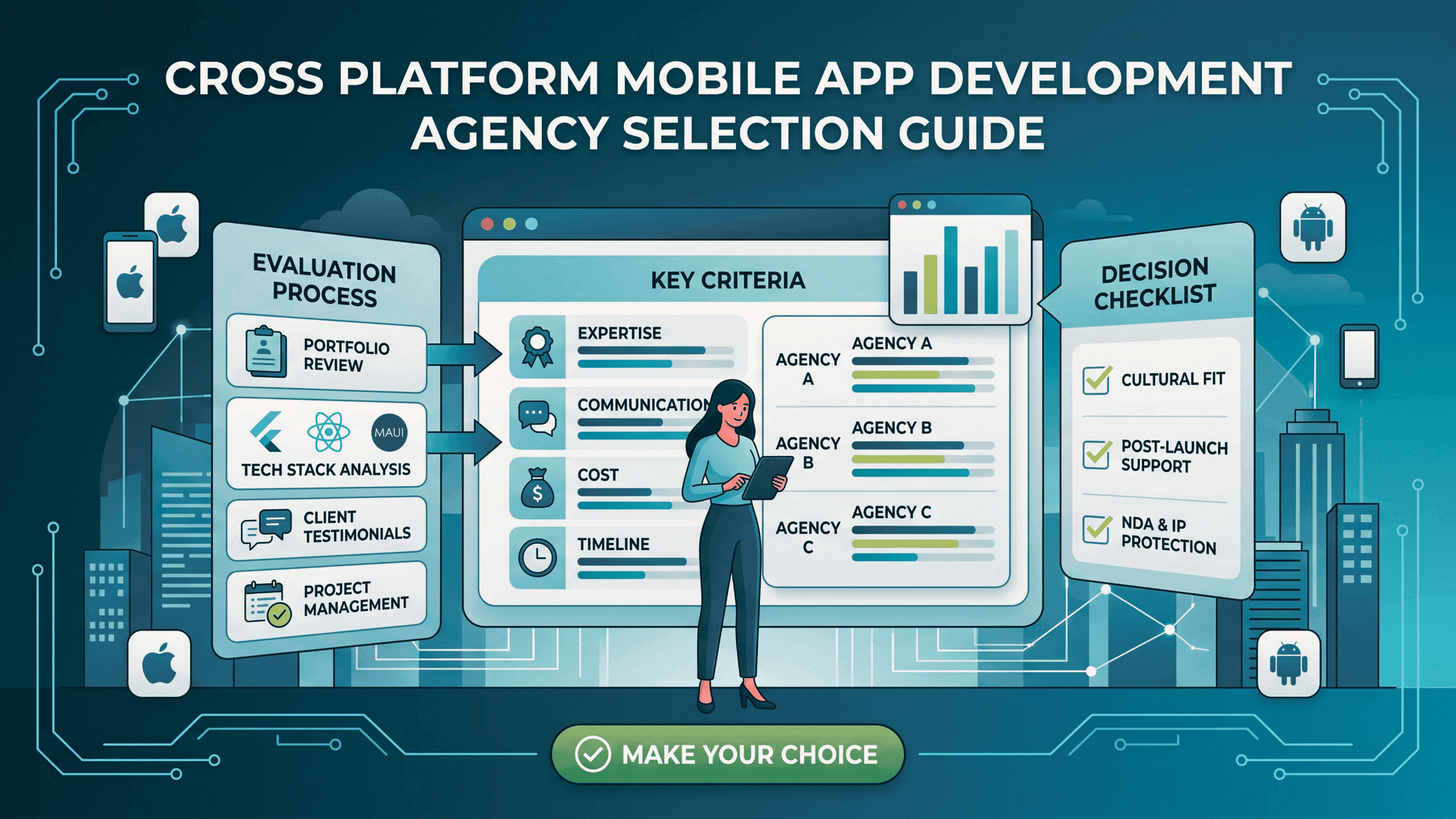
How to Evaluate a Cross Platform Mobile App Development Agency
Evaluating potential agency partners requires looking beyond marketing pitch decks and basic client logos. You need an engineering team with verified experience in scalable architecture and automated testing.
Start by auditing their past software engineering deliverables and public app store ratings. Test their live applications on both budget devices and premium flagships. Look for smooth scrolling performance, quick load times, and responsive user interfaces.
Second, evaluate their technical process for managing state, local caching, and secure authentication. Ask how they handle offline data synchronization for spotty network conditions. A disciplined engineering agency writes modular, well-tested code that scales without accruing technical debt.
Finally, assess their communication standards and product management frameworks. Reliable agencies work transparently through clear sprint cycles and regular progress demonstrations. They act as strategic technology partners rather than passive task executors.
How Much Does Cross Platform App Development Cost
The total cross platform app development cost typically ranges between thirty thousand and one hundred thousand dollars for production-ready applications. Complex enterprise software with custom cloud backends or machine learning integrations can exceed this range.
Your budget depends heavily on functional scope, third-party API integrations, and security requirements. Simple mobile prototypes sit at the lower end of the pricing spectrum. Multi-tier platforms with complex workflows demand greater engineering resources and quality assurance testing.
Working with a single cross-platform agency saves up to forty percent compared to dual native teams. You eliminate redundant design cycles and cut quality assurance efforts in half. This cost efficiency lets you allocate more budget toward growth and user acquisition.
Critical Architectural Pitfalls to Avoid in Mobile Engineering
Cross-platform tools streamline mobile development, but poor engineering practices still destroy application performance. Bad state management leads to memory leaks and lagging user interfaces. Unoptimized image assets and bloated third-party libraries slow down app startup times.
Avoid agencies that build wrapped web views instead of compiled native binaries. Web view wrappers fail to deliver fluid interactive responses on touchscreens. Ensure your development team compiles true native code using Flutter or React Native.
Another common pitfall is ignoring platform-specific UX guidelines during design phases. While business logic remains shared, navigation patterns should feel natural on both operating systems. An experienced team tailors platform interactions without splitting the core code base.
When Cross-Platform Software Is Not the Right Strategic Fit
Cross-platform development offers vast efficiency benefits, but it is not optimal for every single software product. If your application depends heavily on ultra-low latency hardware interfaces, native code is better.
Graphics-heavy 3D gaming applications require direct interaction with native GPU rendering engines. Specialized utilities using custom Bluetooth drivers also perform better with native codebases. In these specialized scenarios, cross-platform abstraction layers introduce unnecessary performance overhead.
If your app relies on brand-new operating system features on launch day, native development helps. Native APIs receive immediate support directly from OS vendors. Cross-platform framework wrappers occasionally require several weeks to support new native capabilities.
How Ideomatics Delivers High-Performance Mobile Applications
At Ideomatics, we engineer scalable digital products tailored to complex business goals. We combine modern software architecture with rigorous continuous integration and automated deployment pipelines.
Our mobile engineering team builds maintainable systems designed for long-term operational success. You can review our past engineering work across our interactive portfolio of client solutions. We partner with founders and enterprise leaders to deliver transparent, measurable software outcomes.
We focus on clean code, strong security standards, and smooth platform performance. By working as an extension of your internal team, we eliminate friction and accelerate delivery. Learn more about our technical history on our company overview page.
Frequently asked questions about cross platform mobile app development agency
What is a cross platform mobile app development agency?
A cross platform mobile app development agency builds software that runs on both iOS and Android from a single codebase. This approach speeds up market entry while reducing overall engineering and maintenance costs significantly. Qualified agencies leverage frameworks like Flutter or React Native to deliver native-quality mobile experiences.
How do cross-platform apps compare to native apps in performance?
Modern cross-platform applications deliver performance that is visually indistinguishable from native apps for most business use cases. Frameworks compile directly into native machine code or utilize dedicated GPU rendering engines. Users enjoy smooth animations, instant touch responses, and high stability.
How much does cross platform app development cost on average?
Average development costs range from thirty thousand to over one hundred thousand dollars based on app complexity. Core factors include backend integration needs, custom UI design, security protocols, and third-party APIs. Choosing cross-platform architecture saves up to forty percent compared to native builds.
How long does it take to build a cross-platform mobile app?
A typical cross-platform app project requires three to six months from initial discovery to app store approval. Early stage MVP applications can launch in eight to twelve weeks. Large enterprise systems take longer due to complex backend connections and testing requirements.
Can an existing native application be migrated to cross-platform?
Yes, native applications can be systematically migrated to modern cross-platform frameworks. Engineering teams can rewrite the product in phases or embed cross-platform modules into the existing native app. This step-by-step migration minimizes risk and prevents service interruptions for existing users.
Ready to launch your next mobile app initiative?
Partner with an engineering studio that prioritizes technical excellence, clear communication, and business scalability. At Ideomatics, we craft custom mobile products engineered for performance and long-term stability. Explore our full suite of digital services or reach out through our contact page to discuss your application goals.