Implementing Enterprise AI Software Engineering Governance in 2026
The traditional software development lifecycle (SDLC) has permanently collapsed. With the emergence of multi-agent engineering runtimes in mid-2026, code is now generated at the speed of thought. Yet, this unconstrained velocity has introduced an existential challenge for enterprise software: the software nondeterminism problem. When autonomous agents generate inconsistent, non-reproducible code paths from identical prompts, classic QA models fracture and technical debt scales exponentially.
To turn machine speed into sustainable business value, tech leaders must shift from raw syntax creation to rigorous operational oversight. Discover the blueprint for policy-driven agent containment, secure filesystem isolation via Model Context Protocol (MCP), and automated runtime verification gates.
Key Benefits
-
Dismantle Codebase Drifting: Establish total architectural control over machine-generated microservices using deterministic validation layers.
-
Implement Policy-Driven Containment: Utilize the newly released Microsoft Execution Containers (MXC) SDK to enforce strict runtime isolation rules on autonomous AI agents.
-
Eliminate Phantom Productivity: Cut through the illusion of raw lines-of-code metrics by measuring actual architectural fit and token efficiency.
-
Secure Intellectual Property: Standardize all external model connections using secure, internal Model Context Protocol infrastructures.
-
Reduce Pipeline Cost Overhead: Minimize runaway token consumption and execution looping using automated token-budget gating mechanisms.
-
Achieve Zero-Flake Verification: Move past fragile HTML selectors by implementing vision-driven AI testing agents operating in secure sandboxes.
QUICK ANSWER
What is enterprise AI software engineering governance, and how does it secure autonomous multi-agent coding workflows?
Enterprise AI software engineering governance is a highly structured architectural framework that establishes operational control, safety guardrails, and deterministic verifiability over autonomous AI coding systems within the software development lifecycle (SDLC). It resolves the software nondeterminism problem where language models generate varying code structures from identical prompt inputs by wrapping probabilistic AI networks in rigid validation layers.
In practice, a governed infrastructure securely paths agent tool-use via the open Model Context Protocol (MCP), confines file and system access using runtime isolation semantics like the Microsoft Execution Containers (MXC) SDK, and forces all generated code through Abstract Syntax Tree (AST) parsers and containerized compilation sandboxes before repository merges occur. This process shifts engineering discipline upstream into precise specification architecture, ensuring corporate codebases remain reliable, maintainable, and fully compliant.
KEY TAKEAWAYS
-
Syntax Is Now a Commodity: The core constraint of modern software production has shifted from code generation velocity down to architectural alignment, code integration, and codebase governance.
-
Relocation of Technical Rigor: Engineering discipline has moved upstream from manual code composition into precise requirement specification, boundary design, and automated verification scripting.
-
The Threat of Nondeterminism: Probabilistic language model outputs require the implementation of strict filtering layers and automated test matrices to guarantee system verifiability.
-
Policy-Driven Containment is Mandatory: Emerging enterprise standards like Microsoft's MXC SDK allow teams to declare precise runtime isolation boundaries, blocking unverified agents from accessing core internal data networks.
-
Standardizing Tooling via WebMCP: Origin trials for WebMCP APIs within Chrome 150/151 provide a standard pathway for frameworks to securely share rich runtime context with AI engineering swarms.
-
The Autonomy Overhang Gap: Technology teams frequently implement highly autonomous agents without upgrading their process frameworks, creating severe pull-request congestion and technical debt.
TABLE OF CONTENTS
-
The 2026 Inflection Point: The Illusion of Generative Velocity
-
The Architecture of Policy-Driven Agent Containment (MXC & MCP)
-
Architectural Indicators: Ungoverned Vibe Coding vs. Governed Topologies
-
Real Business Case Study: Microservice Architecture Consolidation
-
Future Trends: Self-Healing Frameworks and Carbon-Aware Compute
INTRODUCTION
The enterprise software engineering landscape has passed the era of manual code autocomplete tools. In July 2026, the global software development lifecycle is driven by highly autonomous multi-agent engineering runtimes such as Claude Code (Opus 4.7), custom LangGraph swarms, and advanced CLI agent environments. These advanced systems navigate multi-worktree repository environments, execute local terminal commands, analyze compilation trace logs, and autonomously generate and push complex feature branches over extended development cycles. Industry research from mid-2026 indicates that over 44% of enterprise organizations are already running completely machine-generated code inside core production services.
At a superficial level, this automation has triggered an explosion in engineering metrics. The volume of source code generated per developer day has scaled exponentially, pull request turnaround times have dramatically shrunk, and initial boilerplate setup tasks have been reduced to seconds.
However, this unconstrained injection of machine-generated code has driven global IT environments directly into a severe integration and structural crisis.
Tech executives are discovering that the primary bottleneck in contemporary software production is no longer code creation, but codebase integration, architectural synchronization, and long-term system maintainability. When unmanaged agent frameworks operate independently across decoupled software squads, codebases suffer from severe code duplication, skyrocketing code churn, and architectural drift. Compounding this structural fragmentation is the inherent software nondeterminism problem. Because large language models operate on probabilistic next-token predictions rather than fixed, deterministic rule systems, they are fundamentally non-reproducible. An agent executed against identical feature prompts over time will generate varying algorithmic patterns, differing library abstractions, or redundant data schemas. This lack of consistency breaks legacy quality assurance frameworks built entirely around stable, predictable inputs.
To prevent software architectures from fracturing under the weight of unmanaged machine output, organizations must implement comprehensive enterprise AI software engineering governance. This shifting operational terrain demands that technology leaders deliberately relocate engineering rigor away from manual syntax composition upstream into precise boundary design, strict context engineering, and automated runtime verifiability structures.
The 2026 Inflection Point: The Illusion of Generative Velocity
The widespread adoption of autonomous programming engines has broken traditional metrics used to evaluate software development teams. Historically, engineering managers relied on simple indicators like lines of code ($LoC$) shipped, commit frequencies, and ticket closure rates to measure performance. In the modern multi-agent development landscape, these volumetric measurements create a dangerous operational illusion known as phantom developer productivity. Because an autonomous agent runtime can generate an entire application service layer in minutes, high output metrics no longer correlate with real business value. If the generated code block introduces hidden security flaws or creates redundant copies of existing backend components, it inflates long-term system maintenance costs.
Enterprise repository data from July 2026 reveals a critical trend: while code creation velocities have spiked, the time required to triage integration blockers, resolve code duplication errors, and fix architectural drift has expanded.
To capture the true value of automation, technology leaders must recognize that syntax has become a commoditized asset. The true value point of a modern software engineer does not lie in manually typing characters into a code editor, but in validating, controlling, and structuring the boundaries under which autonomous systems operate.
To help organizations move past chaotic, unmanaged code generation into a disciplined platform delivery model, forward-thinking enterprises are investing in professional Ideomatics Custom Software Development frameworks designed specifically to manage AI-scale infrastructure.
Deconstructing Nondeterminism and Code Base Drift
The operational instability introduced by unmanaged AI coding tools stems directly from the mathematical foundation of large language models. Traditional software development is deterministic: an engineer writes an explicit instruction sequence that returns a completely predictable and reproducible output for any given input parameter. Language models, however, are probabilistic networks. They calculate text generation based on statistical weightings, making them inherently non-reproducible over extended execution threads.
This nondeterminism creates severe structural challenges when scaling enterprise software:
-
Regression Tracking Bottlenecks: When an agent updates a feature and returns structurally varied implementation patterns across different runs, tracking down the root cause of a system error becomes a complex manual tracking challenge.
-
Brittle Automated Unit Testing: Traditional testing suites built to check static code parameters frequently report false-positive failures when evaluating non-reproducible software variations that are functionally correct but syntactically unique.
-
Topical Architectural Drift: Without a unified control layer, independent software components slowly drift away from established architectural design patterns, creating isolated maintainability silos.
Managing these non-reproducible behaviors requires wrapping all generative code engines in strict, deterministic verification frameworks. By isolating AI inputs and outputs within hard algorithmic boundaries, companies can maintain the reliability of their systems while capturing the full speed of generative workflows.
Enterprise tech leaders can explore these advanced architectural patterns by following the continuous research updates published on the Ideomatics Blog.
Upstream Evolution: Relocating Engineering Rigor
The realization that autonomous code tools can create unexpected technical debt has forced a complete relocation of technical discipline. As Anthropic's recent 2026 Agentic Coding Trends Report notes, AI automation does not remove the need for engineering discipline it relocates it. In legacy development models, rigor was applied down the line, during manual code composition and extensive post-production quality assurance testing. In a multi-agent development lifecycle, this pattern is too slow to catch machine errors. Engineering rigor must move upstream into the planning, design, and boundary-definition stages of the software development lifecycle. We can model this shift through a formalized balance equation.
In a governed, highly optimized enterprise environment, this index scales dramatically higher, indicating that developers have evolved from active code writers into high-level system orchestrators. Engineers focus their attention on writing explicit validation criteria, setting rigid boundary constraints, and designing systems that are verifiable by design.
This transformation is clearly demonstrated in modern hiring practices. The July 2026 HackerEarth Skills Analysis reports a massive spike in enterprise aptitude and problem-solving screenings, proving that technical hiring has shifted to prioritize logical engineering judgment over familiarity with transient language syntax.
The Architecture of Policy-Driven Agent Containment (MXC & MCP)
Shifting a massive corporate engineering operation to a governed model requires implementing modern runtime isolation frameworks. Tech leaders can no longer allow autonomous tools to execute shell scripts or modify workspaces without strict, policy-driven boundary controls.
The Microsoft Execution Containers (MXC) SDK
Announced in preview in mid-2026, the Microsoft Execution Containers (MXC) SDK represents a major breakthrough for enterprise agent governance. MXC provides a policy-driven execution layer that allows developers to declare precisely what an autonomous agent can access—including specific filesystems, network ports, and internal APIs—with containment boundaries enforced directly at runtime by the operating system.
By integrating MXC protection layers, security and IT managers can constrain local agents to prevent enterprise risk, ensuring that a self-debugging agent cannot inadvertently scan internal networks or execute destructive terminal actions.
Model Context Protocol (MCP) and WebMCP Standardizations
Complementing local OS containment is the widespread adoption of the Model Context Protocol (MCP). MCP standardizes the data transmission highway between language models and development tools.
Furthermore, with the July 2026 origin trials of WebMCP APIs inside Chrome 150/151, frameworks can now share rich, live runtime context with AI coding assistants through standard Imperative and Declarative APIs. This allows development groups to expose securely bounded filesystem roots and testing suites to agent swarms without creating custom API connectors or risking data leakage. To build these advanced, secure automation layers across your organizational systems, companies can achieve total compliance by collaborating with elite Ideomatics AI Automation Solutions architects.
Architectural Indicators: Ungoverned Vibe Coding vs. Governed Topologies
Evaluating whether to upgrade internal development frameworks requires analyzing the clear operational differences between ad-hoc tool adoption and governed architectures.
 Transitioning to an automated, governed development pipeline helps enterprise technology teams eliminate operational bottlenecks while ensuring codebase longevity. Technology leads can explore these architecture transformations by checking out our Ideomatics SaaS Development services.
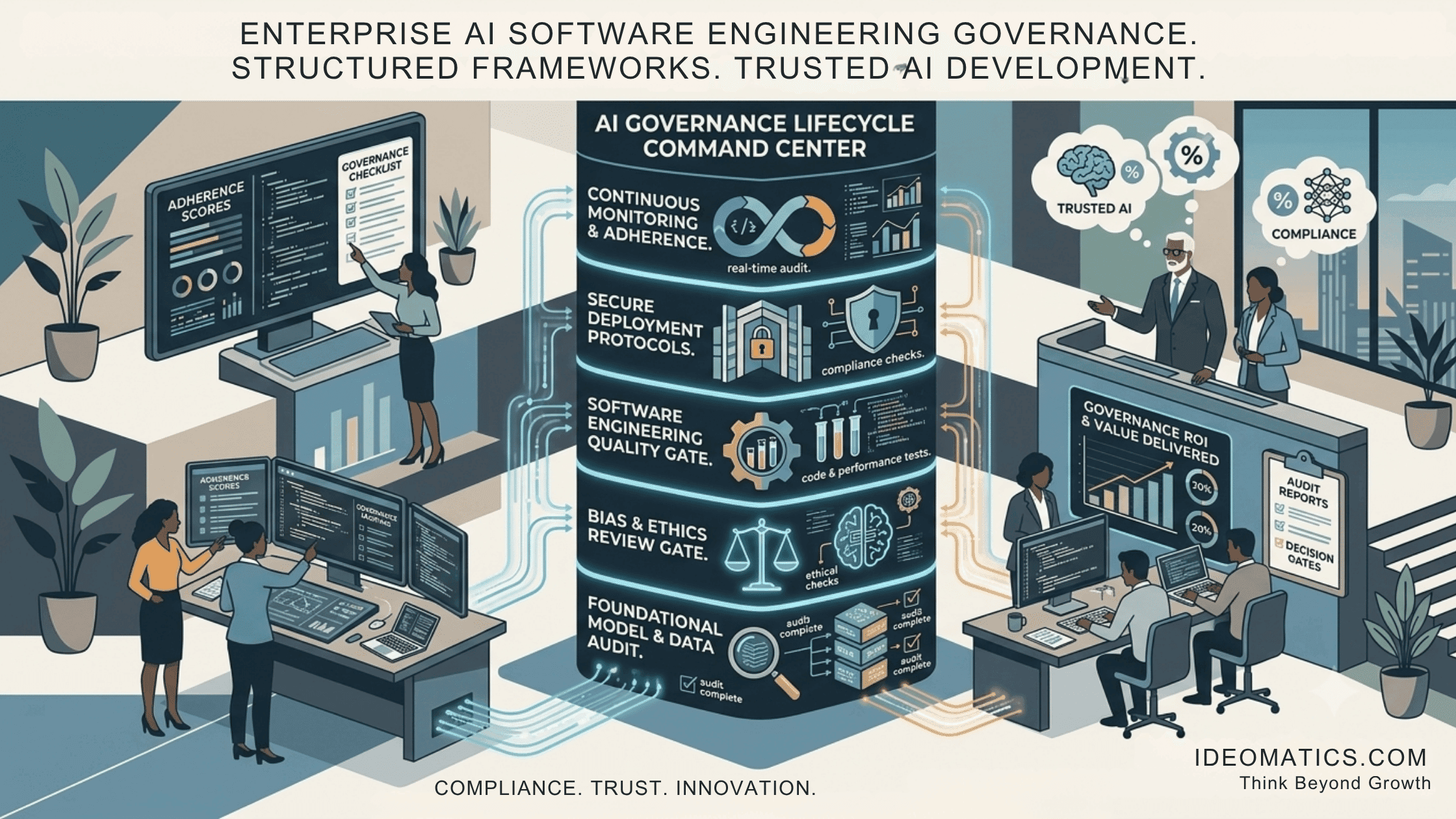
VISUAL SYSTEM BLUEPRINT FOR GOVERNED PIPELINES
This architecture blueprint maps the data routing, security containment blocks, and automated verification loops required to safely process and commit machine-generated code within a governed enterprise development ecosystem.
STEP-BY-STEP GUIDE
Building an Automated AI Software Validation Pipeline
Follow this structured implementation sequence to build secure, automated validation gates directly into your continuous integration frameworks.
-
Enforce Policy-Driven Workspace Sandboxing: Install the Microsoft Execution Containers (MXC) SDK across your staging environments. Write explicit containment policies that confine autonomous agent processes to isolated directory worktrees and block outbound network traffic to unassigned domains.
-
Initialize the WebMCP Context Hub: Deploy localized Model Context Protocol (MCP) servers to handle your repository data layout. Leverage standard WebMCP APIs to share strict style rules and API definitions with incoming AI agents, ensuring the models utilize cached context structures efficiently.
-
Establish Clear Machine-Readable Specifications: Before allowing autonomous tools to generate code additions, require the creation of structured, typed validation schemas (such as Pydantic models). Explicitly declare exact input-output shapes, computational performance budgets, and error-handling conditions.
-
Inject the Automated Profiling Gate: Embed the multi-agent orchestration tool directly into your continuous integration (CI/CD) pipelines (such as GitHub Actions or Jenkins workflows). Configure the pipeline to parse all agent-generated code through Abstract Syntax Tree (AST) tools, checking for duplication coefficients and routing non-compliant files back for automated self-healing before human code reviews.
For software organizations looking to deploy fast, reliable digital solutions across global markets, connecting secure governance gates with optimized web runtimes is a core operational requirement. Learn how our teams design high-performance web systems by exploring Ideomatics Web Development Services.
REAL BUSINESS CASE STUDY
Microservice Architecture Consolidation for Global SaaS Platforms
A major digital enterprise providing global cloud logistics solutions faced severe delivery bottlenecks after rolling out ad-hoc AI coding extensions across its distributed engineering squads. Within five months, raw syntax production velocities accelerated, but the platform's code duplication expanded by 4x, triggering severe pull-request congestion during continuous deployment integration cycles. To resolve this bottleneck, the company collaborated with an external platform modernization team to completely overhaul their delivery infrastructure. They replaced freeform vibe coding models with a disciplined, governed Objective-Validation Protocol.
The implementation team isolated all autonomous agent activities inside policy-driven Microsoft MXC sandboxes, managed repository connectivity through uniform MCP servers, and implemented automated semantic code scanning gates to parse incoming code additions through Abstract Syntax Trees before human reviews.
The implementation completely transformed the company's delivery metrics. While code integration velocities remained high, downstream integration errors dropped by 82%, and production redundancies were eliminated. This case study demonstrates that shifting technical rigor upstream allows enterprise companies to maintain fast development speeds without sacrificing codebase stability.
Common Mistakes in Multi-Agent Pipeline Implementations
-
Evaluating Performance via Raw Code Volume: Measuring developer value strictly through lines of code produced or ticket closure frequencies encourages engineering teams to accept unverified AI code blocks, causing high code churn rates down the line.
-
Granting Unchecked Repository Write Access: Allowing autonomous AI tools to push modifications directly to production repositories without a human-in-the-loop review step introduces severe logic bugs and system safety risks.
-
Neglecting Local Runtime Sandbox Containment: Executing agent-generated shell commands or code compilation tests directly on shared corporate network nodes exposes internal infrastructure to security breaches and data leaks.
-
Allowing Unmanaged Context Window Bloat: Feeding entire multi-million-line code repositories into agent contexts without proper context engineering rules causes prompt decay and drives up token expenses.
Best Practices for Modern Development Leaders
-
Build on Centralized Platform Architectures: Route all code automation routines through a standardized internal developer platform to maintain absolute control over token budgets, compliance tracking, and code quality.
-
Standardize Tool Integration via MCP: Implement the open Model Context Protocol standard as your baseline connectivity layer to manage and track data sharing between repositories and AI agent engines securely.
-
Enforce Complete Git Traceability: Mandate that every modification made by an autonomous software agent is logged to an explicit Git commit history, providing an unalterable audit trail for corporate compliance.
-
Combine Neural Logic with Deterministic Parsers: Protect your platforms from code hallucinations by running machine code through rigid Abstract Syntax Tree parsers and containerized unit tests before accepting changes.
To maintain these automated frameworks over long deployment lifecycles, teams can integrate their testing systems with comprehensive Ideomatics Website Maintenance Services to ensure continuous dependency alignment.
Future Trends: Self-Healing Frameworks and Carbon-Aware Compute
As large language models continue to drop in execution latency and computing costs, enterprise AI governance frameworks will move past passive validation testing toward completely self-healing architecture networks. Future software platforms will utilize continuous background optimization processes that actively trace memory leaks, map out changing system dependencies, and deploy performance fixes automatically.
Furthermore, development lifecycles will shift to utilize advanced cross-platform deployment models that dynamically run computing tasks between local hardware and edge cloud networks based on real-time pricing and server carbon footprint metrics.
Companies can prepare for these emerging technologies by building their core products on flexible, decoupled software structures. Technology leads can stay ahead of these architectural shifts by consulting with our advisors at Ideomatics Software Consulting.
FREQUENTLY ASKED QUESTIONS (FAQ)
What is enterprise AI software engineering governance?
It is a structured management framework that uses automated validation gates, secure runtime sandboxes, and explicit data sharing standards to securely verify and control machine-generated source code within the development pipeline.
How does uncoordinated AI usage introduce technical debt?
Because standard AI assistants operate within narrow prompt windows and lack a global perspective of complex enterprise codebases, they frequently write new, redundant copies of existing functions instead of referencing reusable library patterns, which spikes code duplication.
What is the software nondeterminism problem?
It is an operational challenge where generative language models return structurally varied code blocks or different abstraction choices when executed against identical functional prompts over time, complicating traditional testing pipelines.
How does the Model Context Protocol (MCP) protect enterprise code repos?
MCP provides a secure, uniform data transmission standard that sets hard filesystem boundaries and explicit read-write permissions, preventing AI models from viewing unassigned directories or creating unmonitored repository changes.
Can automated validation engines safely refactor legacy software monoliths?
Yes, provided the AI optimization tools are integrated with deterministic Abstract Syntax Tree (AST) parsers and sandboxed container loops that test and verify every line of code before it is pushed to production.
Does code optimization lower operational cloud computing costs?
Absolutely. Streamlining algorithms, removing dead code paths, and consolidating database queries directly minimizes server CPU and memory usage, lowering monthly cloud infrastructure bills.
How does platform engineering improve AI automation outcomes?
Platform engineering designs and maintains an Internal Developer Platform (IDP) that standardizes the developer experience, giving tech leads a central control point to enforce compliance guardrails, manage token costs, and track code quality.
Where can I find blueprints for enterprise automation and software platforms?
You can explore comprehensive system architectures, live platform implementations, and modern corporate engineering case studies by browsing the Ideomatics Portfolio.
FINAL SUMMARY
The evolution of the software development lifecycle throughout 2026 has proved that achieving long-term technology ROI requires moving past uncoordinated code creation toward disciplined, structured software architecture governance. While autonomous programming tools provide incredible code generation velocity, relying on raw speed without robust process controls leads to severe code duplication, skyrocketing code churn indices, and fractured application environments.
Establishing a modern, resilient software pipeline demands that engineering teams adopt the Objective-Validation Protocol. By shifting technical discipline upstream into precise constraint definition and upfront system design, technology leaders turn their role from active syntax writing into high-level system orchestration.
Implementing these governed frameworks by managing repository connections through uniform MCP servers, isolating automated tool trials inside container sandboxes, and validating code additions through Abstract Syntax Trees allows enterprise companies to capture the full power of AI automation while keeping their core codebases lean, secure, and resilient against technical debt.
Ultimately, long-term competitiveness belongs to organizations that pair human creativity and system discipline with high-performance automation governance.
CALL-TO-ACTION
Building highly performant, scalable software platforms requires moving past ad-hoc code tools toward mature, governed software architectures. Whether your business needs to eliminate technical debt layers, deploy secure multi-agent orchestration frameworks, or design low-latency web platforms, your systems require professional engineering expertise.
At Ideomatics, we design enterprise-grade software solutions engineered for long-term growth and stability. Learn about our core product engineering capabilities by checking out the Ideomatics Portfolio, read about our development philosophy on our About Ideomatics page, or consult directly with an expert systems architect by visiting Contact Ideomatics to modernize your continuous delivery pipelines.