Designing Software Systems for the Multi-Agent Ecosystem
The traditional boundaries of application design have permanently shattered. In 2026, software interfaces are no longer built exclusively for human clicks—they must be designed from the ground up to be safely read, navigated, and controlled by autonomous teams of AI agents. When unmanaged agent swarms operate on legacy architectures, they suffer from context rot, blow through GPU inference budgets, and create hidden technical debt. Discover how the shift toward true agent-native system design, unified tool models, and the atomic Microskill architecture allows modern enterprises to build resilient, self-healing platforms that scale securely.
Key Benefits
-
Eliminate Context Rot: Partition software data into atomic skill capsules to slash language model token consumption by over 90%.
-
Establish Agent UI Parity: Ensure every internal system capability available to a human user is natively readable as a standard tool call by an autonomous agent.
-
Enforce Governed Execution: Synchronize your application's user permission layers directly with agent access boundaries, blocking unauthorized tool use.
-
Secure Ecosystem Connections: Leverage the open standard Model Context Protocol (MCP) and newly deployed WebMCP browser APIs to safely share live runtime context.
-
Minimize Architecture Drift: Prevent machine-generated pull requests from fragmenting your systems by enforcing a unified, spec-driven development protocol.
-
Cut Testing Overhead: Move past fragile testing code paths by utilizing autonomous visual testing swarms that validate UI elements in isolated containers.
QUICK ANSWER
What is an agent-native architecture, and how does it relate to enterprise AI software engineering governance?
An agent-native architecture is an advanced software design paradigm where applications are engineered from the ground up to allow both human users and autonomous AI agents to operate the same product through a unified framework of shared actions, data structures, permission models, and active system context. Instead of forcing AI models to navigate applications via fragile frontend screen-scraping or unmanaged API hooks, an agent-native application exposes its core features through protocol-ready standard interfaces like the Model Context Protocol (MCP).
Within an enterprise AI software engineering governance model, this architecture serves as the critical control point. It ensures that autonomous agent swarms execute multi-step workflows—such as planning, coding, and deploying software components—under strict compliance guidelines. By wrapping probabilistic AI decisions in deterministic validation gates, container sandboxes, and modular Microskill knowledge capsules, the system maintains complete codebase integrity, eliminates architectural drift, and prevents unauthorized system mutations.
KEY TAKEAWAYS
-
The Paradigm Shift: Applications are evolving from static multi-page human interfaces into dynamic, protocol-ready collections of autonomous AI agents operating on unified data planes.
-
Shared Action Models: Modern software patterns demand a single definition for every system capability, exposing features simultaneously as a visual component for humans and a structured tool call for agents.
-
The Reality of Context Rot: Language model accuracy degrades by over 32% as context windows scale past 32,000 tokens; resolving this failure requires transitioning from massive prompts to atomic context engineering.
-
The Microskill Architecture: Partitioning codebase repositories into encapsulated, sharply scoped skill blocks reduces token waste by 90% while doubling first-try terminal compilation rates.
-
WebMCP Browser Integration: Origin trials for WebMCP APIs within Chrome 150/151 provide a standard pathway for browser-based agents to securely access live application state without risking corporate data leakage.
-
Relocating Engineering Discipline: Software engineering priorities have permanently transitioned from manual line-by-line syntax generation upstream into precise specification design, constraint architecture, and automated verification validation.
TABLE OF CONTENTS
-
The 2026 Shift: From AI-Augmented to Agent-Native Applications
-
The Microskill Architecture: Mitigating Context Rot and Token Bloat
-
Standardizing the Integration Layer: MCP and WebMCP Origin Trials
-
The Spec-Driven Development Model: Relocating Rigor Upstream
-
Comparative Analysis: Legacy SaaS Frameworks vs. Agent-Native Ecosystems
-
System Flow Mapping: Governed Multi-Agent Execution Topologies
-
Real Business Case Study: Workflow Automation in Enterprise Logistics
-
[Future Horizons: Recursive Language Models and Carbon-Aware Compute
INTRODUCTION
The software development lifecycle has passed the phase of basic generative code completions. In July 2026, the enterprise engineering landscape is shaped by autonomous multi-agent runtimes such as Claude Code, advanced LangGraph networks, and terminal-native execution swarms. These systems do not merely suggest lines of code inside a developer's editor; they operate independently over extended, days-long task horizons, decomposing complex feature requests, managing multi-worktree repository environments, executing local terminal tests, and deploying containerized microservices with minimal human intervention. Recent market forecasts confirm that over 40% of enterprise software applications will feature task-specific autonomous AI agents integrated directly into their operational fabrics by the end of 2026.
However, this rapid, unmanaged transition to agentic automation has exposed a critical architectural flaw inside legacy software systems. Almost every enterprise software platform currently in production was engineered explicitly for human interaction relying on visual dashboard clicks, multi-step session sign-ins, and regional interface rendering fields. When autonomous agent swarms attempt to operate these human-centric monoliths, they are forced to rely on slow, brittle frontend screen-scraping methods, or execute uncoordinated, freeform code patches that bypass established security controls and trigger severe structural logic errors. Compounding this integration challenge is the inherent software nondeterminism problem. Because large language models analyze code through probabilistic weightings rather than fixed rule matrices, they are fundamentally non-reproducible over long execution cycles. This statistical fluctuation leads directly to high short-term code churn, duplicated database schemas, and topical architectural drift across distributed development groups.
To turn machine speed into predictable, long-term business value, enterprise technology leaders must implement comprehensive enterprise AI software engineering governance. Navigating this paradigm shift requires moving past basic API wrappers to design true agent-native software architectures relocating software development rigor away from manual syntax writing upstream into precise programmatic constraint design, context engineering, and automated runtime verifiability structures.
From AI-Augmented to Agent-Native Applications
The early waves of generative artificial intelligence in software development operated strictly as an enhancement layer. Developers integrated basic chat blocks and text completion widgets into their existing integrated development environments (IDEs) to help write initial function boilerplate, draft markdown comments, or scan isolated methods for syntax errors. While this phase delivered a significant boost to initial code draft speeds, it left the core operational architecture of the underlying applications unchanged. Developers still manually managed the integration loops, reviewed dependencies, and tracked deployment states.
In mid-2026, the industry has reached a structural turning point. The market is shifting rapidly from simply adding AI features to existing tools toward full-scale AI-first engineering and agent-native product design. High-performing engineering teams have realized that treating AI as an ad-hoc assistant creates a massive development bottleneck down the line, characterized by phantom developer productivity where agents generate massive volumes of fast syntax code that ultimately triggers deep integration crashes during build runs.
To capture true, sustainable delivery acceleration, software must be built from the ground up so that human engineers and autonomous agent teams can seamlessly operate the same system through a single, shared configuration layer. Technology leads looking to upgrade their legacy platforms into highly scalable, automated corporate assets achieve this by partnering with elite Ideomatics Custom Software Development experts to rebuild their systems around native automation principles.
Core Architectural Principles of the Agent-Native Blueprint
Building a production-ready, agent-native application requires a complete departure from human-centric design patterns. Tech leaders must implement four core architectural principles across their development pipelines to ensure machine actions remain secure, trackable, and computationally efficient.
1. Agent UI Parity
This foundational rule states that anything a human user can execute through an application's visual interface, an autonomous agent must be able to execute natively through a structured, programmatic tool call. The agent must interact directly with the system's underlying capabilities, completely eliminating the need for slow, error-prone frontend screen-scraping.
2. One Shared Action Model
Instead of maintaining distinct execution code blocks for frontend human interactions and backend machine APIs, an agent-native application defines its core actions—such as generating an analytical report, modifying a user record, or triggering an environment deployment—exactly once within a unified layer. The human visual UI maps directly to this single action definition, while autonomous agents read the exact same schema as a standard tool call option.
3. Shared State, Data, and Active Context Tracks
An autonomous agent cannot operate effectively in isolation; it requires real-time clarity into what the human operator is currently viewing, which dashboard filters are active, and what dataset modifications occurred while it was running in the background. The central database functions as a real-time coordination fabric, synchronizing context instantly between the human interface and parallel agent execution paths.
4. Governed Execution and Permission Synchronization
An autonomous agent must always operate under the exact same access governance rules and security permissions as the human user it represents. If a corporate user is restricted from viewing specific financial ledgers or altering customer database schemas, their assigned AI agent swarm must be programmatically blocked from calling those tools on their behalf, preventing security leaks.
Organizations looking to establish this unified coordination fabric across their customer-facing products can build highly performant global foundations by leveraging tailored Ideomatics SaaS Development systems.
The Microskill Architecture: Mitigating Context Rot and Token Bloat
One of the single largest barriers to scaling production-grade autonomous agent systems is a technical failure known as context rot. Comprehensive cloud computing research from 2026 reveals that large language model accuracy degrades by over 32% the moment a prompt context window scales past 32,000 tokens long before hitting theoretical million-token model limits. Models suffer from the "lost in the middle" phenomenon, where critical code rules or variable constraints buried mid-context are completely ignored by the model's attention layers, leading to code hallucinations and structural design violations.
To eliminate this computational decay, advanced enterprise software frameworks are adopting the Microskill Architecture. Inspired by microservices, this design paradigm splits knowledge encapsulation rather than service routing. Instead of feeding a long-running agent your entire multi-million-line codebase, the system partitions your application repository into atomic, sharply scoped "skill capsules."
When an agent is assigned a bug fix or a feature extension, the orchestrator node serves only the specific, micro-targeted skill capsule required for that explicit execution path.
Production data from teams utilizing the Microskill paradigm confirms a massive 90% reduction in raw token consumption, while first-try terminal compilation success rates nearly double. By keeping context maps highly focused, organizations can eliminate structural design breaks completely while cutting down on expensive GPU inference overhead. Tech leads can implement these advanced structural scanning steps across their digital properties by leveraging comprehensive Ideomatics Website Maintenance Services.
Standardizing the Integration Layer: MCP and WebMCP Origin Trials
Managing communications safely between autonomous model networks and enterprise file systems requires implementing open standard layers. The technology community has standardized this highway through the Model Context Protocol (MCP). MCP provides an open, uniform protocol for data transmission between AI clients and local or remote development tools, removing the need to write custom API connectors for every single tool iteration.
The capabilities of this protocol layer have expanded through the highly anticipated WebMCP origin trials inside Chrome 150/151. WebMCP exposes standard Imperative and Declarative APIs directly within the browser runtime environment.
This standard allows browser-based autonomous agents to securely request live application state, read database schemas, and trigger system actions through verified browser sandboxes, avoiding the security risks of custom plugin extensions.
By standardizing your integration highway around WebMCP standards, your systems become natively accessible to advanced developer tools without exposing sensitive source frameworks to external data servers. To learn more about modern, secure API orchestration patterns, check out our comprehensive overview of Ideomatics API Integration Services.
The Spec-Driven Development Model: Relocating Rigor Upstream
The realization that autonomous multi-agent systems can create unexpected technical debt has forced a fundamental shift in how engineering discipline is applied. As technology leads navigate the modern SDLC, it has become clear that AI automation does not remove the need for software engineering rigor it relocates it.
In legacy software delivery pipelines, rigor was focused down the line, during manual line-by-line code writing and post-production quality assurance testing. In an agent-native ecosystem, this model is too slow to catch machine errors. Engineering rigor must move upstream into the planning, design, and boundary-definition stages of the software development lifecycle, utilizing a methodology known as Spec-Driven Development.
Under this governance framework, human developers evolve from syntax writers into high-level system architects. Their day-to-day discipline is applied to writing explicit, machine-readable validation criteria, setting strict token-budget limits, and designing system constraints using typed schemas (such as Pydantic configurations). The assigned agent networks are then confined strictly within this execution loop, running parallel code generation rounds inside isolated container sandboxes until every automated constraint is fully satisfied.
Enterprises can successfully close internal process gaps and deploy these advanced automated workflows by collaborating with specialized Ideomatics AI Automation Solutions architects.
COMPARISON TABLES
To evaluate how infrastructure design affects development performance, technology leads can review this operational capability matrix comparing legacy frameworks with agent-native systems.
 Transitioning to an agent-native software structure helps enterprise platforms lower overall cloud computing overhead while accelerating product release timelines. To see how these high-performance patterns scale across consumer touchpoints, explore Ideomatics Web Development Services.
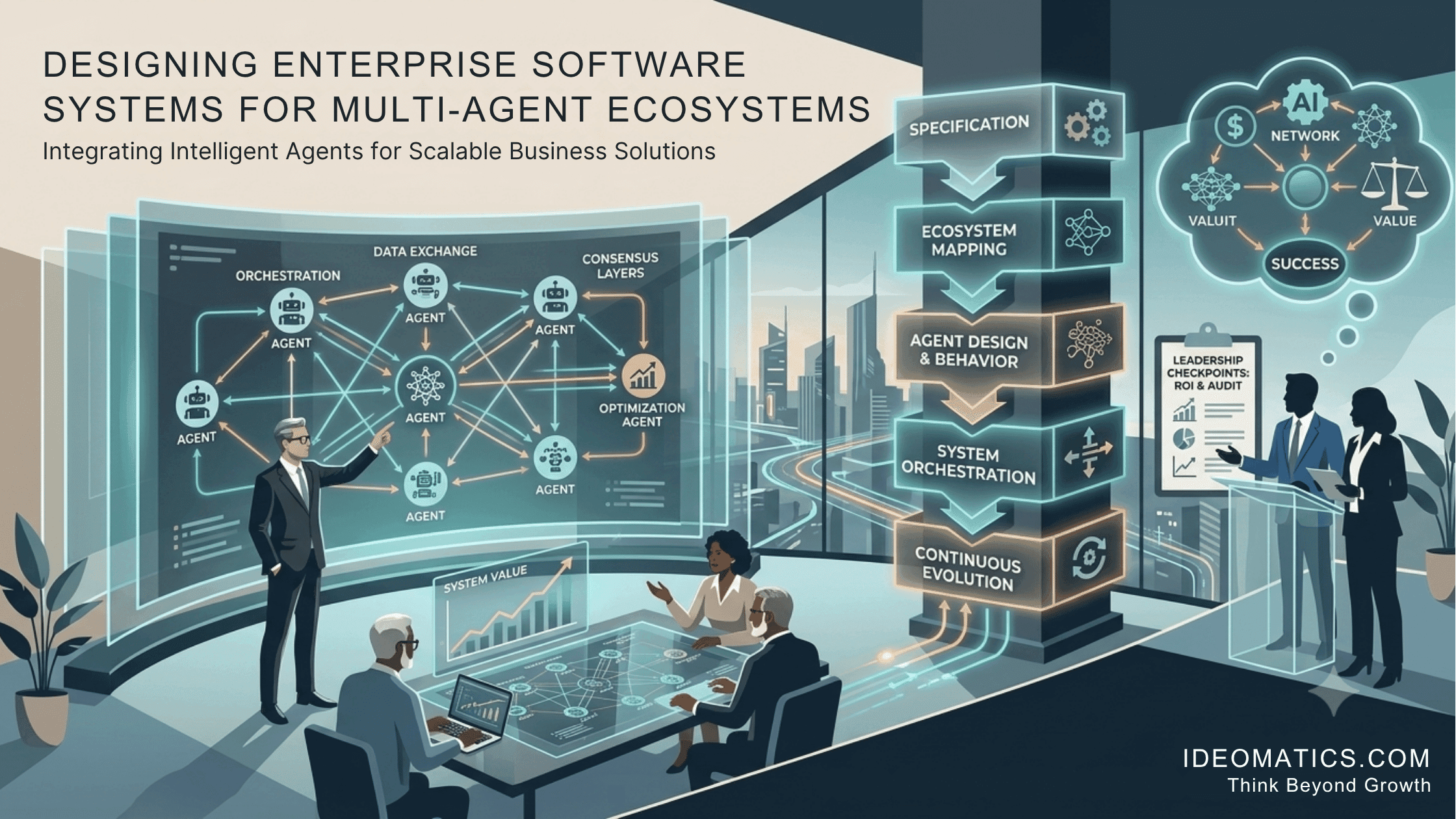
GOVERNED MULTI-AGENT EXECUTION TOPOLOGIES
This system design blueprint outlines the secure data routing, validation gates, and sandbox environments required to run an agent-native architecture under a comprehensive corporate governance model.
STEP-BY-STEP BLUEPRINT FOR BUILDING AN AGENT-NATIVE MODULE
Phase 1: Define a Single Shared Action Layer
Deconstruct your application features into isolated, single-purpose service methods. Write these capabilities so they accept and return strictly validated, machine-readable JSON payloads, allowing both human user interfaces and autonomous agents to call the exact same underlying capability.
Phase 2: Expose Infrastructure via MCP Servers
Set up a localized Model Context Protocol (MCP) server across your development network. Write explicit configuration parameters that expose your shared action schemas, filesystem sub-trees, and testing scripts to incoming AI models under strict read-write access rules.
Phase 3: Partition Repository into Microskill Capsules
Audit your application source tree and isolate dependencies into atomic, sharply scoped skill blocks. Ensure each capsule contains only the localized logic, API contracts, and structural rules needed to execute its narrow task, preventing context rot during agent optimization runs.
Phase 4: Inject Automated AST Validation Gates
Connect an automated validation engine directly into your continuous integration (CI/CD) pipelines. Configure the pipeline to run all agent-generated pull requests through Abstract Syntax Tree (AST) parsers and sandboxed unit tests, ensuring all machine output matches your core design standards before human code reviews.
To ensure your automated systems operate with maximum performance across multi-platform layouts, tech teams can coordinate their engineering setups with Ideomatics Mobile App Development strategies.
WORKFLOW AUTOMATION IN ENTERPRISE LOGISTICS
A major international fulfillment provider faced severe delivery delays and soaring technical debt after deploying ad-hoc AI coding helpers across its legacy supply-chain management software. While the raw speed of initial code drafts accelerated, the lack of centralized coordination caused code duplication to jump by 4x, causing frequent build crashes during weekly deployment integrations.
To eliminate this friction, the logistics company partnered with an external platform modernization team to restructure their application core using an agent-native architecture model. They broke down their uncoordinated development tools and rebuilt their backend using the modular Microskill paradigm.
The engineering team encapsulated system capabilities into atomic skill blocks, standardized data transmission through uniform MCP server setups, and introduced strict WebMCP browser validation gates.
The transformation completely optimized the company's operational capacity. By moving to a shared action framework, specialized sub-agents could work in parallel coordinating tasks across candidate screening pipelines, automated shipping manifest generation, and real-time inventory adjustments smoothly.
The implementation slashed raw token consumption overhead by 90% while doubling first-try terminal compilation success metrics. Most critically, the time required to fully staff and launch a new distribution hub plummeted from over a week down to less than 72 hours, demonstrating the real business value of governed software automation.
Common Mistakes in Multi-Agent Software Deployments
-
Relying on Freeform Vibe Coding Models: Allowing unconstrained language models to write and inject code directly into repositories without strict machine-readable specifications causes rapid architectural fragmentation.
-
Neglecting Context Window Attenuation: Feeding massive, global repository code paths into agent contexts without applying context engineering principles triggers token bloat and context rot.
-
Granting Unchecked User Permissions: Failing to synchronize an application's authorization profiles with agent tool execution limits introduces critical compliance and data safety liabilities.
-
Deploying Prototypes Without Scalable Architectures: Attempting to run parallel, long-running agent loops over legacy infrastructure without connection pooling proxies causes rapid server resource exhaustion.
Best Practices for Modern Platform Engineering Leaders
-
Standardize Ecosystem Connections via MCP: Implement the open standard Model Context Protocol as your baseline connectivity layer to manage data transmission between model networks and internal systems securely.
-
Enforce Strict Microskill Encapsulation: Partition your application core repositories into modular skill capsules to cut token waste and optimize model reasoning accuracy.
-
Incorporate Deterministic Validation Layers: Protect your source repositories from code hallucinations by running all machine output through containerized compilers and AST syntax checks before review stages.
-
Maintain Complete Git Trail Auditability: Mandate that every system mutation executed by an autonomous AI worker is logged to an explicit Git commit lineage, providing an unalterable tracking trail for compliance.
To maintain these automated testing pipelines smoothly over long deployment lifecycles, organizations can integrate their platforms with comprehensive Ideomatics UI/UX Design Services to balance complex backend validation with seamless front-facing experiences.
Future Horizons: Recursive Language Models and Carbon-Aware Compute
As foundational models continue to shrink in physical size while expanding in analytical capacity, the architecture of enterprise applications will move toward completely decentralized, self-healing code networks. Future platforms will run continuous background optimization loops driven by Recursive Language Models (RLMs) that actively trace hidden memory leaks, optimize complex database query pathways, and patch security vulnerabilities automatically.
Furthermore, development lifecycles will shift to utilize advanced, carbon-aware cloud orchestrators. These systems will dynamically scale multi-agent workloads between local terminal environments and edge cloud runtimes based on real-time execution pricing and localized grid clean energy intensities.
Companies can stay ahead of these emerging technologies by building their core systems on flexible, decoupled software frameworks. Technology leads can map out their long-term modernization strategies by consulting with our advisors at Ideomatics Software Consulting.
FREQUENTLY ASKED QUESTIONS
What is an agent-native architecture?
It is a software design pattern where applications are engineered from the ground up to allow both human users and autonomous AI agents to operate the same product through a unified framework of shared actions, data models, and permission boundaries.
How does the Microskill architecture prevent context rot?
By partitioning a massive codebase repository into atomic, sharply scoped skill blocks, ensuring language models process only high-signal data tokens and eliminating the logical confusion caused by massive context windows.
What role does the Model Context Protocol (MCP) play in software governance?
MCP serves as an open, uniform standard that establishes secure communication and data transmission boundaries between AI models and developer tooling, file systems, and repository networks.
What are WebMCP browser APIs?
WebMCP browser APIs are standard interfaces currently in origin trials that allow browser-based autonomous agents to securely access live application state and trigger tools without requiring custom browser plugins.
Can agent-native platforms lower cloud compute infrastructure costs?
Yes. By replacing heavy cloud-hosted virtual machines with lightweight V8 isolates and leveraging token-efficient context engineering patterns, agent-native systems reduce both server CPU time and GPU inference bills.
What is spec-driven development in an AI-first SDLC?
A development model where human engineers focus on designing machine-readable specifications, token budgets, and verification guardrails, requiring autonomous agent networks to write code that satisfies every constraint.
How do you stop autonomous agents from corrupting production databases?
By isolating all automated agent operations inside secure, temporary container sandboxes and routing data changes through connection pooling proxies that enforce strict user permission profiles.
Where can I find blueprints and case studies for enterprise software modernization?
You can explore comprehensive system architectures, live platform implementations, and modern corporate engineering case studies by browsing the Ideomatics Portfolio.
FINAL SUMMARY
The rapid evolution of the software development lifecycle throughout 2026 has demonstrated that achieving sustainable technology ROI requires moving past basic code assistants toward disciplined, agent-native architectures. While autonomous programming tools deliver remarkable code generation velocity, relying on raw speed without robust process governance leads to severe code duplication, skyrocketing code churn rates, and fragmented software systems.
Establishing a modern, resilient software pipeline demands that engineering teams adopt the Spec-Driven Development model. By shifting technical discipline upstream into precise constraint definition and upfront system design, technology leaders transform their role from active syntax writing into high-level system orchestration.
Implementing these governed frameworks by managing repository connections through uniform MCP servers, isolating automated tool trials inside container sandboxes, and partitioning codebase files into atomic Microskill capsules allows enterprise companies to capture the full power of AI automation while keeping their core codebases lean, secure, and resilient against technical debt.
Ultimately, long-term market advantage belongs to organizations that pair human architectural creativity and system discipline with high-performance automation governance.
CALL-TO-ACTION
Building highly performant, scalable software platforms requires moving past ad-hoc code tools toward mature, governed agent-native architectures. Whether your business needs to eliminate technical debt layers, deploy secure multi-agent orchestration frameworks, or design low-latency web platforms, your systems require professional engineering expertise.
At Ideomatics, we design enterprise-grade software solutions engineered for long-term growth and stability. Learn about our core product engineering capabilities by checking out the Ideomatics Portfolio, read about our development philosophy on our About Ideomatics page, or consult directly with an expert systems architect by visiting Contact Ideomatics to modernize your continuous delivery pipelines.