AI Integration for Business Without Replacing Existing Systems
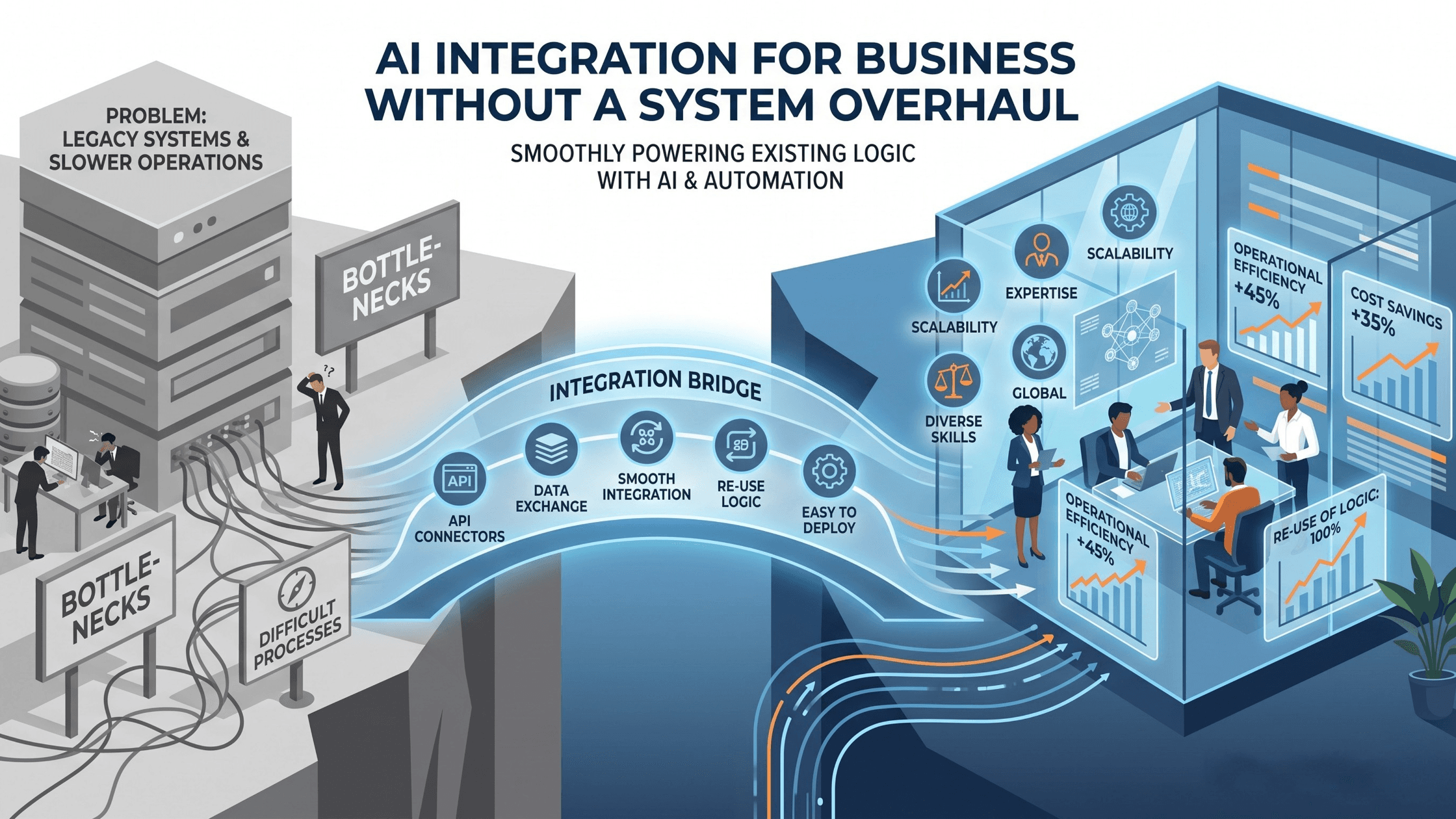
You do not need to replace your software stack to use artificial intelligence. Modern ai integration for business allows you to connect intelligent models directly to existing databases and workflows. This approach saves time and protects your prior technology investments.
At Ideomatics, we help companies enhance operational tools without breaking established workflows. We build light API layers that route data between your systems and artificial intelligence engines. You gain modern capabilities while maintaining stable core operations.
How Do You Integrate AI Into Existing Systems?
You integrate artificial intelligence by connecting pre-trained or fine-tuned language models to existing software using middleware APIs. This strategy leaves your operational databases intact while adding automated reasoning on top.
First, your development team identifies high-value manual steps in current workflows. Second, developers create clean API endpoints to pass structured text or documents to an external model. Finally, the model returns processed outputs back into your core user interfaces.
This modular structure keeps your main system architecture simple and secure. It also prevents vendor lock-in because you can swap underlying intelligence models whenever better options emerge.
Practical Ways to Enhance Core Workflows
Many leaders assume adding intelligence requires massive platform overhauls. In reality, applied ai works best when targeting specific bottle-necks in existing processes.
For example, customer support teams often struggle with slow email response times. A background service can read incoming tickets, query internal policy documents, and draft responses. Support agents simply review and send the generated replies.
Similarly, finance teams process unstructured invoices manually every day. An intelligent extraction pipeline reads incoming PDFs, extracts line items, and updates your current ERP system. Your team retains complete control over approval workflows.
To explore how these solutions fit your infrastructure, review our applied AI services. We design practical components that plug directly into existing business applications.
Protecting Data Residency and Local Compliance
Enterprise leaders, particularly across the Gulf region, prioritize data privacy and strict data residency. Sending sensitive corporate records to public cloud services raises immediate regulatory risks.
Fortunately, modern ai integration for business does not force you to send data overseas. You can deploy open-weights models inside your own local cloud infrastructure. This ensures complete control over data sovereignty.
Alternatively, enterprise providers offer regional cloud endpoints with strict zero data retention policies. Your operational data processes locally and never trains public foundation models.
We help organizations design compliant architectures that meet strict regional governance mandates. You can read about our engineering standards on our company page.
The Role of AI Automation in Daily Operations
Repetitive administrative tasks consume thousands of staff hours every month. Implementing targeted ai automation eliminates this operational toil without disrupting existing team routines.
Instead of retraining employees on new platforms, smart scripts work behind your familiar tools. Automation services can summarize lengthy client calls, categorize lead inquiries, and sync internal task boards automatically.
These automated assistants reduce human error significantly. Staff members spend less time entering data and more time delivering value to clients.
Most importantly, automated pipelines scale effortlessly as transaction volumes grow. You increase operational output without doubling administrative headcount or rebuilding legacy databases.
AI for Small Business: High Impact on Small Budgets
Enterprise tools often carry massive price tags and long deployment cycles. However, practical ai for small business focuses on fast, low-risk deployments.
Small teams usually suffer from limited administrative capacity. By adding targeted intelligent plugins to current platforms, small companies multiply their staff productivity overnight.
You do not need dedicated data science departments to start seeing results. Standard cloud interfaces and fine-tuned lightweight models deliver immediate practical benefits.
A modest initial investment in API integration often yields positive returns within weeks. Small businesses gain enterprise-grade capabilities while staying lean and agile.
When Custom AI Integration Is Not the Right Choice
We believe in complete transparency about technology choices. Adding artificial intelligence to your company is not always the correct decision.
If your core data is messy or unorganized, language models will produce unreliable results. You must clean your underlying data sources before connecting automated tools.
Furthermore, if your legacy software lacks basic API capabilities, integration costs escalate rapidly. In those cases, building new custom web platforms is often more cost-effective. You can review our web development services for full system upgrades.
Finally, simple rule-based automation is better for fixed, predictable logic. Do not pay for complex probabilistic models when basic database scripts solve the problem efficiently.
Frequently asked questions about ai integration for business
How much does it cost to get started with AI integration?
A focused integration project typically costs between five thousand and fifteen thousand dollars. The exact price depends on system complexity, security requirements, and data readiness. Smaller pilot projects cost less because they focus on a single workflow.
How long does an AI integration project take?
Most initial integration projects take four to eight weeks from discovery to production launch. Simple API integrations can launch even faster. Complex deployments with strict data residency controls require additional testing time.
What is the step-by-step process for adding AI?
We begin by auditing your current workflows and data sources. Next, we build a light API middleware layer to connect your systems to secure models. Finally, we test outputs, train your staff, and monitor production performance.
How do we choose between cloud and local AI models?
Choose public enterprise cloud models if you need maximum reasoning power and standard compliance. Select local or private cloud models if you have strict regional data residency rules. We evaluate your regulatory requirements to recommend the best option.
What happens if an AI model produces wrong answers?
We design system guardrails and keep human reviewers in the loop for sensitive decisions. The software flags low-confidence responses for manual validation before taking action. This prevents incorrect outputs from affecting your core operations.
Work With Ideomatics to Upgrade Your Systems
Adding modern capabilities to your company should not require breaking what already works. We design reliable, scalable integrations tailored to your existing software architecture.
Our team brings deep expertise in custom software, cloud infrastructure, and intelligent workflow automation. We ensure every deployment delivers clear operational value, high security, and measurable ROI.
Ready to automate repetitive tasks and upgrade your software stack cleanly? Reach out through our contact page to discuss your project with our engineering team.