Custom Software vs Off-the-Shelf Solutions: Which Fits Your Business?
Custom software vs off-the-shelf: which fits your business? Compare cost, scalability, and ROI. Get expert guidance from IDEAMATICS. Request a consultation
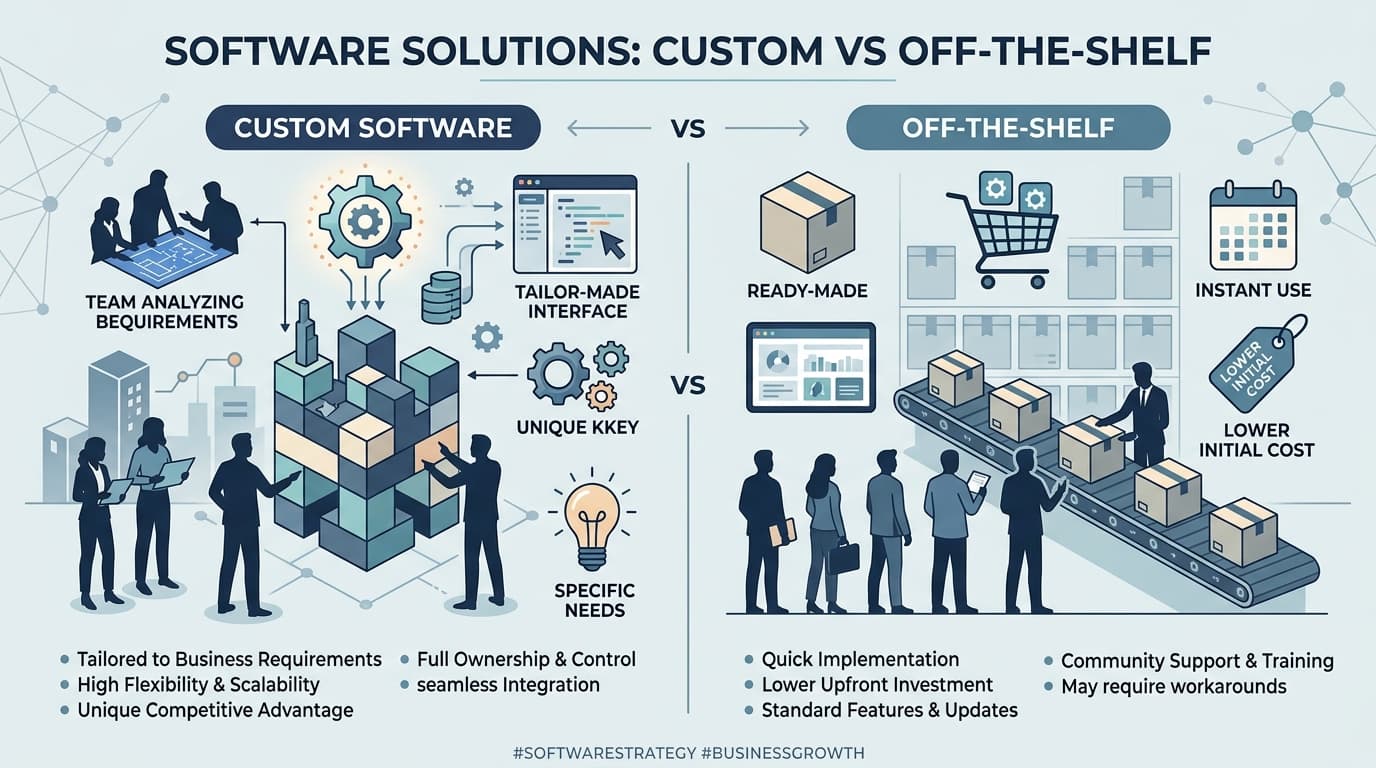
The build-or-buy question every growing business eventually faces You need software. The real question is: do you buy something ready-made off the shelf, or do you build something designed specifically around the way your organization actually works? It sounds straightforward. It rarely is. Both paths have genuine merit. Both have real trade-offs. And making the wrong call, whether that means overpaying for features you will never touch or locking yourself into a generic tool that stunts your growth, costs more than most teams realize until it is too late. At IDEAMATICS, we have spent decades helping organizations navigate exactly this decision, from federal agencies to private-sector enterprises. Here is how we think about it. What each option actually means Off-the-shelf software is any pre-built application designed for broad use. Think payroll platforms, standard CRM tools, basic project management apps. The vendor builds a product for the widest possible audience, you license access, and you adapt your processes to fit what the software does. It deploys fast. It costs less upfront. And for genuinely standard business functions, it often does the job well. Custom software is built from scratch, or purpose-extended from a foundation, to match your specific workflows, data structures, integrations, and business logic. Nobody else has exactly what you have. You own it. It does precisely what you need it to do, and nothing more, nothing less. The market tells an interesting story here. The global custom software development market was valued at $43 billion in 2024 and is projected to reach $146 billion by 2030 , growing at a compound annual rate of 22.6%. That trajectory is not a coincidence. It reflects a growing recognition that off-the-shelf tools, however convenient, have a ceiling. The real cost comparison: short-term vs. long-term This is where most comparisons go wrong. They look at the upfront price tag and stop there. That is not how total cost of ownership works. Off-the-shelf software is cheaper to start. Licenses are predictable, deployment is fast, and you can be operational within days. But the costs compound over time. Seat-based pricing escalates as your team grows. Add-on modules cost extra. Customization, where it is even possible, is time-consuming and expensive. And you are paying for a sprawling feature set, most of which you will never use. Research from Pendo found that 80% of SaaS features go untouched by enterprise users , representing billions in wasted development costs passed onto customers through subscription fees. Custom software flips that curve. The upfront investment is significant, there is no point pretending otherwise. But once built, your ongoing costs are primarily hosting and maintenance. No per-seat fees. No feature paywalls. No forced upgrades that break your workflows. For a mid-market firm, the break-even point typically arrives around month 33. After that, the economics tilt decisively toward the bespoke solution. Off-the-shelf wins on: Speed to deploy, lower initial spend, predictable short-term budgeting Custom software wins on: Total cost of ownership beyond year two, zero feature bloat, no vendor-driven pricing increases One figure worth sitting with: 53% of enterprise SaaS licenses sit completely idle at any given time. That is not a small inefficiency. It is a structural cost that compounds quietly every quarter. Scalability, integration, and control Here is where off-the-shelf solutions start to show their limits for complex or growing organizations. Generic tools are built to serve the average use case. When your workflows are not average, which is true for most organizations doing anything genuinely specialized, the friction starts immediately. You end up bending your processes to match the software instead of the other way around. The average enterprise now runs more than 900 applications , and integration gaps between those tools remain the single biggest barrier to digital transformation, according to MuleSoft's 2024 findings. Custom software is designed to fit inside your existing environment. It talks to your current systems, your legacy data, your APIs. It scales on your terms, not on the vendor's pricing tiers. And critically, you own the code, the data, and the intellectual property . If your business model evolves, your software can evolve with it. You are not waiting on a vendor roadmap or submitting a feature request that may or may not appear two years from now. Security is another dimension that generic tools handle generically. For regulated industries, especially defense, government, finance, and healthcare, that generic approach often falls short of compliance requirements. Custom software allows you to implement precise, sector-specific security controls from the ground up, rather than retrofitting a consumer-grade product to meet enterprise or regulatory standards. When off-the-shelf is the right answer Honest advice: off-the-shelf software is genuinely the better choice in certain situations. It would be wrong to pretend otherwise. If your needs are standard, your team is small, and speed matters more than fit, a pre-built tool will serve you well. Basic accounting, HR management for a team under 100, email marketing, straightforward project tracking: these are categories where the generic solution is robust, affordable, and fast. There is no competitive advantage to be gained from building a custom payroll system when a proven one already exists for a fraction of the cost. The off-the-shelf case is strongest when: Your workflows match what the vendor built for (and you have verified this, not assumed it) You need to be operational within days or weeks The function is not a differentiator for your business Your budget genuinely cannot absorb a custom build right now Your team has the bandwidth to adapt processes to the tool The honest caveat: even in these cases, check the long-term licensing trajectory before committing. What costs $200 a month today may cost $800 a month in three years once your seat count grows and the vendor adjusts its pricing tiers. When custom software is the right investment Custom development earns its cost when the software itself is a source of competitive advantage, not just an operational tool. If you have built proprietary workflows, unique customer experiences, or data processes that competitors cannot replicate, generic software actively undermines that edge. It forces you onto the same rails every other business in your industry is using. Custom software protects and amplifies what makes you different. It is also the right path when integration is non-negotiable. Complex technology stacks, particularly those involving enterprise resource planning, workforce management, legacy government systems, or real-time data pipelines, regularly exceed what off-the-shelf tools can connect to reliably. Building around your existing environment, rather than fighting it, saves significant operational cost over time. Organizations using custom-built platforms report productivity gains of 35 to 40% on average compared to pre-build alternatives, with revenue growth tracking 20% higher over a three-year window. Those numbers reflect what happens when the software fits the organization rather than the organization fitting the software. Industries where the case for bespoke software is strongest include healthcare, logistics, finance, defense, and any sector with complex regulatory requirements or highly specialized operational workflows. A practical decision framework Before committing to either path, work through these five questions honestly: Is this function a differentiator? If yes, custom. If no, off-the-shelf is a reasonable starting point. How complex are your integrations? The more systems the software needs to talk to, the stronger the case for building something designed around your stack. What does the three-year cost actually look like? Model the total cost of ownership, not the monthly subscription, including seat escalations, add-ons, and customization fees. What is your growth trajectory? A tool that fits today may constrain you badly in eighteen months. Build that into the decision. What are the security and compliance requirements? Regulated industries often cannot meet their obligations with a generic product, full stop. A score of 3 or more of these pointing toward custom is a strong signal that the investment will pay off. Fewer than 3 and off-the-shelf deserves serious consideration first. What do the numbers say? The data on this debate has sharpened considerably over the last two years. Custom software reaches cost parity with SaaS tools within two to three years for most mid-market organizations, after which it consistently outperforms on total cost of ownership. Productivity improvements of 35 to 40% are reported by companies that replace generic tools with purpose-built platforms. Meanwhile, 53% of enterprise SaaS licenses go unused at any given time, representing tens of millions in annual waste per large organization. And the global custom software market is growing at 22.6% annually, a rate that reflects genuine organizational demand, not vendor marketing. Low-code and no-code acceleration is also reducing build timelines, with Gartner projecting that 70% of new business applications will incorporate low-code components by 2026, making custom development faster and more accessible than it was even three years ago. Custom Software vs Off-the-Shelf: Key Data Points SaaS features never used 80% Productivity gain (custom platforms) 40% Enterprise SaaS licenses sitting idle 53% Custom market CAGR (2024-2030) 22.6% New apps using low-code by 2026 70% © ideamatics.com FAQ: Custom software vs off-the-shelf solutions How much more does custom software cost than off-the-shelf? Upfront, custom software typically requires a significantly higher investment than a standard SaaS license. However, when you model total cost of ownership over three to five years, including license escalations, seat fees, add-on modules, and workaround costs, custom solutions generally reach cost parity around year two to three and outperform beyond that. The right comparison is not month-one cost. It is five-year total spend versus five-year operational value. How long does it take to build custom software? It depends on scope and complexity. A focused MVP or a targeted custom module can be delivered in six to twelve weeks with the right development approach. A full enterprise system is typically a multi-month engagement. The timeline is longer than deploying off-the-shelf, but modern development practices, including Agile sprints and low-code acceleration, have shortened build cycles considerably compared to even five years ago. Can custom software integrate with my existing tools and systems? Yes, and this is one of its strongest arguments. Custom software is architected around your existing environment, not the other way around. It can be built to connect with your current ERP, CRM, legacy databases, APIs, and data pipelines from the ground up. Off-the-shelf tools rely on pre-built connectors that may not cover your stack, and deep integrations often require expensive middleware or workarounds. Is off-the-shelf software ever the better choice? Absolutely. For standard, non-differentiating business functions such as basic HR management, email marketing, or straightforward accounting, off-the-shelf tools are often faster, cheaper, and entirely sufficient. The key test is whether the software function is part of your competitive advantage. If it is not, a proven pre-built product is a perfectly rational choice. If it is, generic tools will limit you over time. What industries benefit most from custom software development? Industries with complex workflows, strict regulatory requirements, or highly specialized data processes see the strongest ROI from custom builds. That includes defense and government contracting, healthcare, financial services, logistics, and manufacturing. Any sector where off-the-shelf tools cannot meet compliance standards, or where unique operational logic is a genuine differentiator, is a strong candidate for a bespoke solution.