Designing Enterprise Software Systems for Multi-Agent Ecosystems
As autonomous software engineering swarms transition from simple code-completion widgets into full-lifecycle developers, traditional container paradigms face critical structural failures. Transitioning to a true enterprise AI software engineering governance model requires adopting an agent-native application blueprint backed by the modular Microskill architecture. Discover how standardizing runtime layers via the Model Context Protocol (MCP) and enforcing shared authorization boundaries enables organizations to eliminate context rot, slash token consumption by 90%, and deploy self-healing digital systems.
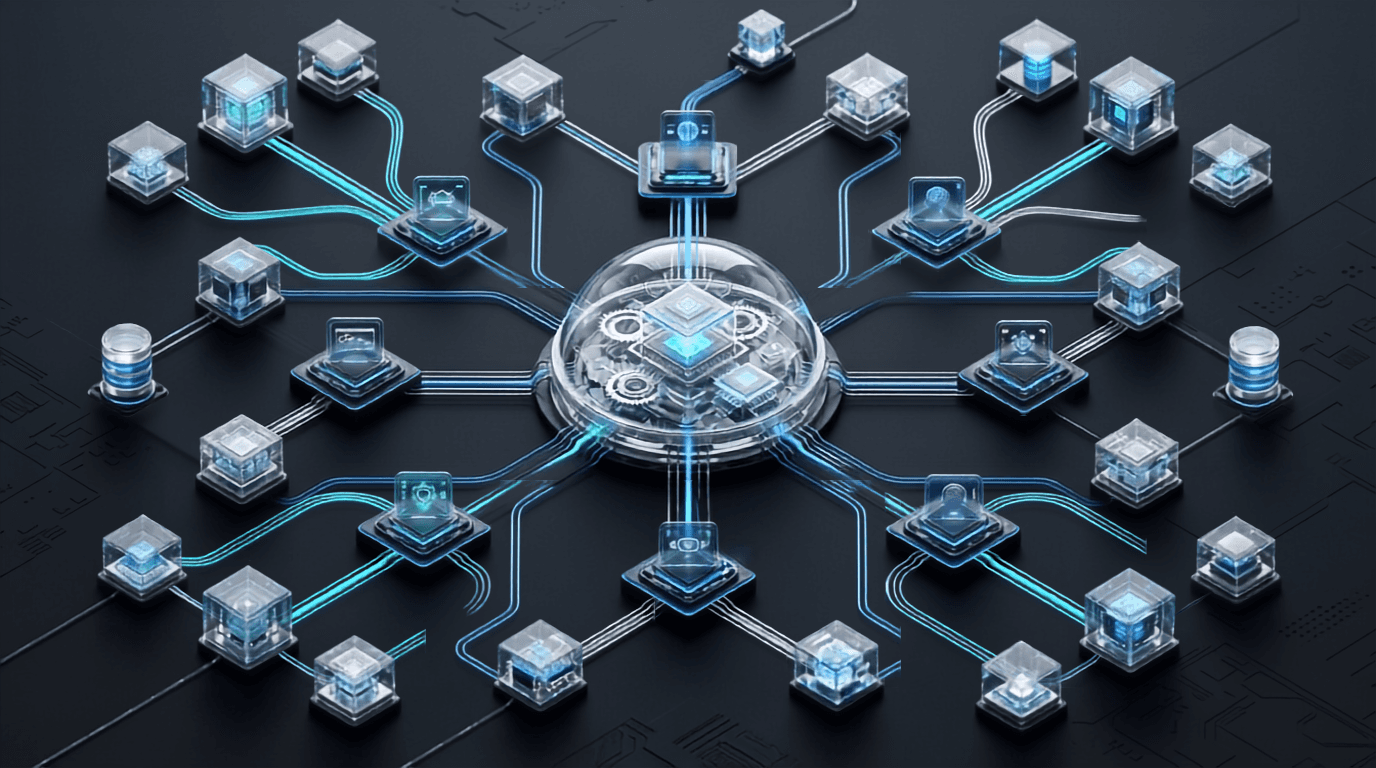
An agent-native architecture is an advanced software design paradigm where applications are engineered from the ground up to allow both human users and autonomous AI agents to operate the same product through a unified framework of shared actions, data structures, permission models, and active system context. Instead of forcing AI models to navigate applications via fragile frontend screen-scraping or unmanaged API hooks, an agent-native application exposes its core features through protocol-ready standard interfaces like the **Model Context Protocol (MCP)**.
Within an [enterprise AI software engineering governance](https://) model, this architecture serves as the critical control point. It ensures that autonomous agent swarms execute multi-step workflows—such as planning, coding, and deploying software components—under strict compliance guidelines. By wrapping probabilistic AI decisions in deterministic validation gates, container sandboxes, and modular Microskill knowledge capsules, the system maintains complete codebase integrity, eliminates architectural drift, and prevents unauthorized system mutations.
2. [Core Architectural Principles of the Agent-Native Blueprint ](https://) 3. [The Microskill Architecture: Mitigating Context Rot and Token Bloat](https://)
4. [Standardizing the Integration Layer: MCP and WebMCP Origin Trials ](https://) 5. [The Spec-Driven Development Model: Relocating Rigor Upstream](https://)
6. [Comparative Analysis: Legacy SaaS Frameworks vs. Agent-Native Ecosystems](https://)
7. [System Flow Mapping: Governed Multi-Agent Execution Topologies](https://)
8. [Step-by-Step Blueprint for Building an Agent-Native Module ](https://) 9. [Real Business Case Study: Workflow Automation in Enterprise Logistics](https://)
10. [Common Mistakes in Multi-Agent Software Deployments](https://)
11. [Best Practices for Modern Platform Engineering Leaders ](https://) 12. [[Future Horizons: Recursive Language Models and Carbon-Aware Compute](https://)
13. [Frequently Asked Questions](https://)
However, this rapid, unmanaged transition to agentic automation has exposed a critical architectural flaw inside legacy software systems. Almost every enterprise software platform currently in production was engineered explicitly for human interaction relying on visual dashboard clicks, multi-step session sign-ins, and regional interface rendering fields. When autonomous agent swarms attempt to operate these human-centric monoliths, they are forced to rely on slow, brittle frontend screen-scraping methods, or execute uncoordinated, freeform code patches that bypass established security controls and trigger severe structural logic errors. Compounding this integration challenge is the inherent software nondeterminism problem. Because large language models analyze code through probabilistic weightings rather than fixed rule matrices, they are fundamentally non-reproducible over long execution cycles. This statistical fluctuation leads directly to high short-term code churn, duplicated database schemas, and topical architectural drift across distributed development groups.
To turn machine speed into predictable, long-term business value, enterprise technology leaders must implement comprehensive **enterprise AI software engineering governance**. Navigating this paradigm shift requires moving past basic API wrappers to design true agent-native software architectures relocating software development rigor away from manual syntax writing upstream into precise programmatic constraint design, context engineering, and automated runtime verifiability structures.
In mid-2026, the industry has reached a structural turning point. The market is shifting rapidly from simply adding AI features to existing tools toward full-scale **AI-first engineering and agent-native product design**. High-performing engineering teams have realized that treating AI as an ad-hoc assistant creates a massive development bottleneck down the line, characterized by phantom developer productivity where agents generate massive volumes of fast syntax code that ultimately triggers deep integration crashes during build runs.
To capture true, sustainable delivery acceleration, software must be built from the ground up so that human engineers and autonomous agent teams can seamlessly operate the same system through a single, shared configuration layer. Technology leads looking to upgrade their legacy platforms into highly scalable, automated corporate assets achieve this by partnering with elite [Ideomatics Custom Software Development](https://) experts to rebuild their systems around native automation principles.
Organizations looking to establish this unified coordination fabric across their customer-facing products can build highly performant global foundations by leveraging tailored [Ideomatics SaaS Development](https://) systems.
To eliminate this computational decay, advanced enterprise software frameworks are adopting the **Microskill Architecture**. Inspired by microservices, this design paradigm splits knowledge encapsulation rather than service routing. Instead of feeding a long-running agent your entire multi-million-line codebase, the system partitions your application repository into atomic, sharply scoped "skill capsules."
When an agent is assigned a bug fix or a feature extension, the orchestrator node serves only the specific, micro-targeted skill capsule required for that explicit execution path.
Production data from teams utilizing the Microskill paradigm confirms a massive **90% reduction in raw token consumption**, while first-try terminal compilation success rates nearly double. By keeping context maps highly focused, organizations can eliminate structural design breaks completely while cutting down on expensive GPU inference overhead. Tech leads can implement these advanced structural scanning steps across their digital properties by leveraging comprehensive [Ideomatics Website Maintenance Services](https://).
The capabilities of this protocol layer have expanded through the highly anticipated **WebMCP origin trials** inside Chrome 150/151. WebMCP exposes standard Imperative and Declarative APIs directly within the browser runtime environment.
This standard allows browser-based autonomous agents to securely request live application state, read database schemas, and trigger system actions through verified browser sandboxes, avoiding the security risks of custom plugin extensions.
By standardizing your integration highway around WebMCP standards, your systems become natively accessible to advanced developer tools without exposing sensitive source frameworks to external data servers. To learn more about modern, secure API orchestration patterns, check out our comprehensive overview of [Ideomatics API Integration Services](https://).
In legacy software delivery pipelines, rigor was focused down the line, during manual line-by-line code writing and post-production quality assurance testing. In an agent-native ecosystem, this model is too slow to catch machine errors. Engineering rigor must move upstream into the planning, design, and boundary-definition stages of the software development lifecycle, utilizing a methodology known as **Spec-Driven Development**.
Under this governance framework, human developers evolve from syntax writers into high-level system architects. Their day-to-day discipline is applied to writing explicit, machine-readable validation criteria, setting strict token-budget limits, and designing system constraints using typed schemas (such as Pydantic configurations). The assigned agent networks are then confined strictly within this execution loop, running parallel code generation rounds inside isolated container sandboxes until every automated constraint is fully satisfied.
Enterprises can successfully close internal process gaps and deploy these advanced automated workflows by collaborating with specialized [Ideomatics AI Automation Solutions](https://) architects.
To ensure your automated systems operate with maximum performance across multi-platform layouts, tech teams can coordinate their engineering setups with [Ideomatics Mobile App Development](https://) strategies.
To eliminate this friction, the logistics company partnered with an external platform modernization team to restructure their application core using an agent-native architecture model. They broke down their uncoordinated development tools and rebuilt their backend using the modular Microskill paradigm.
The engineering team encapsulated system capabilities into atomic skill blocks, standardized data transmission through uniform MCP server setups, and introduced strict WebMCP browser validation gates.
The transformation completely optimized the company's operational capacity. By moving to a shared action framework, specialized sub-agents could work in parallel coordinating tasks across candidate screening pipelines, automated shipping manifest generation, and real-time inventory adjustments smoothly.
The implementation slashed raw token consumption overhead by 90% while doubling first-try terminal compilation success metrics. Most critically, the time required to fully staff and launch a new distribution hub plummeted from over a week down to less than 72 hours, demonstrating the real business value of governed software automation.
To maintain these automated testing pipelines smoothly over long deployment lifecycles, organizations can integrate their platforms with comprehensive [Ideomatics UI/UX Design Services](https://) to balance complex backend validation with seamless front-facing experiences.
Furthermore, development lifecycles will shift to utilize advanced, carbon-aware cloud orchestrators. These systems will dynamically scale multi-agent workloads between local terminal environments and edge cloud runtimes based on real-time execution pricing and localized grid clean energy intensities.
Companies can stay ahead of these emerging technologies by building their core systems on flexible, decoupled software frameworks. Technology leads can map out their long-term modernization strategies by consulting with our advisors at [Ideomatics Software Consulting](https://).
Establishing a modern, resilient software pipeline demands that engineering teams adopt the Spec-Driven Development model. By shifting technical discipline upstream into precise constraint definition and upfront system design, technology leaders transform their role from active syntax writing into high-level system orchestration.
Implementing these governed frameworks by managing repository connections through uniform MCP servers, isolating automated tool trials inside container sandboxes, and partitioning codebase files into atomic Microskill capsules allows enterprise companies to capture the full power of AI automation while keeping their core codebases lean, secure, and resilient against technical debt.
Ultimately, long-term market advantage belongs to organizations that pair human architectural creativity and system discipline with high-performance automation governance.
At Ideomatics, we design enterprise-grade software solutions engineered for long-term growth and stability. Learn about our core product engineering capabilities by checking out the [Ideomatics Portfolio](https://), read about our development philosophy on our [About Ideomatics page](https://), or consult directly with an expert systems architect by visiting [Contact Ideomatics](https://) to modernize your continuous delivery pipelines.